Bank Bonus vs Higher APY: Which Actually Earns You More?
Two Offers, One Pile Of Savings
Arithmetic settles this one: for most savers with a small starting balance the bonus wins, while a large balance you rarely touch earns more from the higher rate.
Open a comparison site and two kinds of offer compete for the same money. One promises a cash bonus for opening an account and meeting a few conditions. The other promises a rate a fraction of a point above everyone else.
They look like the same kind of deal. They are not, and the difference is arithmetic rather than opinion.
A bonus is a fixed amount that does not care how much you deposit. A rate is a percentage that cares about nothing else.
That single distinction decides which offer is worth your time, and it flips at a balance you can calculate in about a minute.
The Short Version

Take the bonus if your balance is small and you can meet the requirements comfortably. On a few thousand in savings, a one-time cash payment usually beats a modest rate advantage for the first year.
Take the higher rate if your balance is large or growing. A rate compounds every year without any conditions, while a bonus arrives once and never returns.
The crossover sits where the annual rate advantage equals the bonus. Below it, the bonus wins. Above it, the rate wins, and it keeps winning every year after.
What A Cash Bonus Really Costs To Earn
A bonus is marketing spend, and banks attach conditions that make it profitable for them. The most common is a qualifying direct deposit, which is designed to move your salary rather than your savings.
The second is a minimum balance held for a set number of days. That locks money in place, sometimes at a rate below what you were earning elsewhere.
The third is a holding period on the account itself. Close it too early and the bank can reclaim the bonus, charge a closure fee, or both.
Each condition has a cost even when you meet it. Money parked at a low promotional rate for ninety days is money not earning at a better one, and that gap comes straight off the headline figure.
Where A Rate Advantage Quietly Wins
A rate has no paperwork. There is no deposit to schedule, no window to miss, and no clawback if life changes and you need the money in week three.
It also scales without limit. Every additional dollar you save earns the advantage, which is why the rate route suits anyone building a balance rather than parking one.
It compounds. A bonus is a single event, and a rate difference repeats annually as long as both accounts keep their relative position.
That last point comes with a caveat. Savings rates are variable, and today’s leader can drift toward the middle within months. Our roundup of high-yield savings accounts covers how to judge a bank on more than a single headline number.
Doing The Arithmetic Yourself
The table below shows the crossover directly. It assumes a rate advantage of one percentage point over your current account, held for twelve months, against a one-time bonus of two hundred. Both figures are illustrative, so substitute the real numbers from the offers in front of you.
| Balance held | Extra interest from a 1 point rate gap, one year | Example one-time bonus | Which wins in year one | Which wins by year three |
|---|---|---|---|---|
| $2,000 | About $20 | $200 | Bonus, by a wide margin | Bonus |
| $5,000 | About $50 | $200 | Bonus | Bonus |
| $10,000 | About $100 | $200 | Bonus | Rate |
| $20,000 | About $200 | $200 | Roughly even | Rate |
| $40,000 | About $400 | $200 | Rate | Rate, decisively |
| $75,000 | About $750 | $200 | Rate | Rate, decisively |
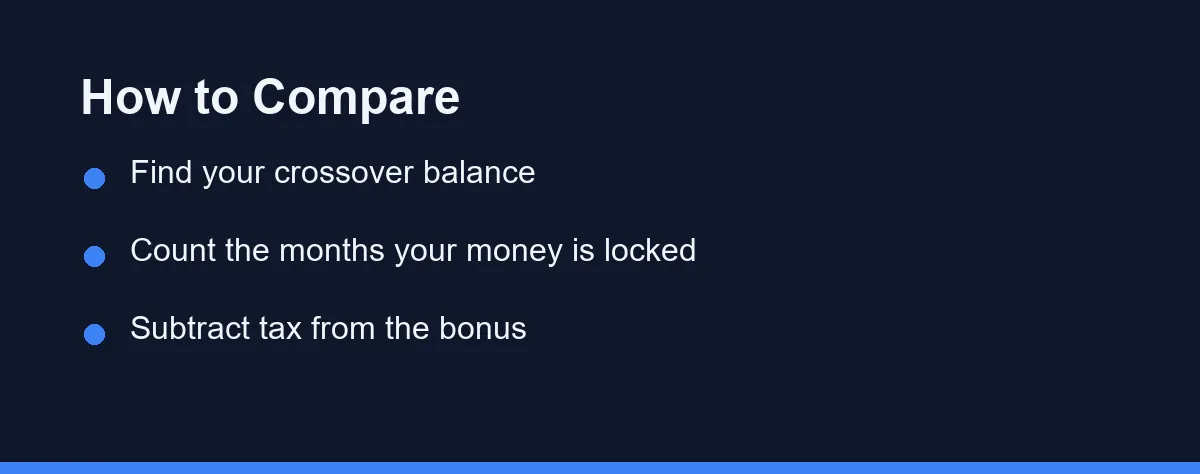
Two lessons fall out of the table. The crossover in year one sits near twenty thousand under these assumptions, and it moves down every year you keep the account.
Change the assumptions and the crossover moves with them. A half-point rate gap doubles the balance needed, and a larger bonus pushes the crossover higher.
Run your own version before deciding. Multiply your balance by the rate difference expressed as a decimal, then compare that number to the bonus after tax.
The Requirements That Decide Who Qualifies
Direct deposit rules are the most common disqualifier. Many banks accept only payroll or government deposits, and a manual transfer from another bank does not count.
Freelancers and anyone paid through an invoicing platform run into this constantly. If your income does not arrive as a recognised payroll deposit, read the definition carefully before counting on the offer.
Minimum balance rules are the second filter. Holding a large sum for ninety days is easy with an emergency fund already saved and difficult on a starter balance.
Account limits are the third. Banks often restrict bonuses to new customers, or to people who have not held an account there within the past year or two.
Chasing either offer usually means moving your direct deposit and autopays, which is where the real risk sits. Our guide to switching banks without missing a payment sets out the order to do it in.
Timing is the fourth, and the one people misjudge most. Offers usually specify a deadline for opening, a separate window for the qualifying deposit, and a date by which the balance must still be there.
Write those three dates in a calendar the day you open the account. A bonus lost to a missed window is worse than never applying, because the money moved for nothing.
Read the fee schedule alongside the offer terms as well. Our guide to fees on high-yield savings accounts covers the charges that quietly reduce either option.
Two Worked Examples
Consider a saver with three thousand set aside and a steady salary paid by payroll deposit. A one percentage point rate advantage earns about thirty over a year, and a two hundred bonus dwarfs it.
The requirements are also easy for that saver to meet. The salary already arrives as a qualifying deposit, and the minimum balance sits below what is already in the account.
Now consider a freelancer with forty thousand in savings and invoice-based income. The same rate advantage earns about four hundred a year, every year, with no conditions attached.
That freelancer probably cannot qualify for the bonus at all, since client payments rarely count as direct deposits. The rate is not only better here, it is the only option genuinely available.
Both examples use round figures for clarity rather than any specific offer. The method is what transfers: multiply your balance by the rate gap, compare it to the bonus after tax, and check whether you qualify at all.
Tax Turns A Bonus Into Something Smaller
Account bonuses are treated as income. Banks generally report them as interest, and you receive a tax form covering the year the bonus landed.
That means the headline figure is not what you keep. A two hundred bonus is worth meaningfully less after tax, and the exact reduction depends on your marginal rate.
Interest from a higher rate is taxed the same way, so tax does not favour one option over the other. It simply shrinks both, and it shrinks the bonus in a single year rather than gradually.
The practical effect is to move the crossover balance down. Our guide to taxes on high-yield savings interest walks through how savings income is reported.
Which Offer Fits Your Balance

Starting out with a few thousand saved: Take the bonus, if you can meet the direct deposit requirement without disruption. A fixed payment on a small balance is a large percentage return.
Building an emergency fund you may need suddenly: Take the rate. Locking a balance for ninety days conflicts with the entire purpose of the fund, and missing the condition forfeits the bonus anyway.
Holding a large balance you rarely touch: Take the rate, and stop reading bonus offers. At that size the annual advantage exceeds most bonuses within the first year.
Paid as a freelancer or contractor: Check the direct deposit definition first. If your income does not qualify, the bonus is not available to you regardless of the balance.
Organised, with time and several accounts already: Both, in sequence. Park the main balance in the best available rate and use a smaller account to meet bonus requirements.
Uncomfortable with paperwork or deadlines: Take the rate. Bonus conditions punish forgetfulness, and a missed window turns the whole exercise into wasted effort.
What Rates And Fees Look Like In Practice
Online-only banks tend to compete on rate, since they carry no branch costs and want deposits. Large national banks more often compete with cash offers, because they are buying a primary banking relationship rather than a savings balance.
Promotional rates deserve particular care. A rate that applies only for six months, or only up to a balance cap, is closer to a bonus than to a genuine ongoing advantage.
Watch fees on both sides. Monthly maintenance charges, minimum balance penalties, and early closure fees can erase either offer, and they are listed in the fee schedule rather than the advertisement.
Rates and terms change frequently, so confirm current figures on the bank’s official site rather than trusting a comparison page. Everything described here reflects how these products are structured at the time of writing, not a specific offer. Because most bonuses attach to a checking account rather than savings, our checking vs savings account explainer is worth reading before you move anything.
The Habit That Beats Both Offers
Chasing offers produces a scattered set of accounts, several tax forms, and a mental burden that most people abandon within a year. The savers who do best usually pick one strong account and keep adding to it.
That said, one well-chosen bonus early in a savings journey is genuinely worth having. On a small balance it can equal several years of rate advantage, and the requirements are easiest to meet when your income is steady.
The order that works for most people is simple. Take a bonus once, while the balance is small, then move the money to the best sustainable rate and leave it alone.
Then check the rate once or twice a year rather than monthly. If your bank has drifted well below the leaders, move. If it has not, the time is better spent on the deposit amount than on the rate, since contributions outrun rate differences at almost every balance. Our guide on how many savings accounts you should have helps decide how far to spread the money.
This article is general education, not financial advice. Bonus conditions, rates, and fees move frequently, so read the offer terms and confirm the current details with the bank before you commit.
FAQ
Is a bank bonus better than a higher interest rate?
It depends almost entirely on your balance. A one-time cash bonus is a fixed amount, while a rate advantage pays a percentage, so the bonus wins on small balances and the higher rate wins once the balance is large enough. Work out the crossover point before choosing.
Do you pay tax on a bank account bonus?
Yes. Banks report account opening bonuses to the tax authority, usually as interest income, and you receive a tax form for the year you received it. That reduces the real value of the offer, and it applies to the interest you earn as well.
What are the usual requirements for a bank sign-up bonus?
Most bonuses require a qualifying direct deposit within a set window, a minimum balance held for a number of days, or both. Missing the window by a day usually voids the offer entirely. Read the requirements before moving any money.
Can a bank take back a bonus if you close the account?
Many banks require the account to stay open for a period, often several months, and can claw back the bonus if you close early. Some also charge an early closure fee. Check both the clawback window and the fee schedule before you plan an exit.
Is chasing bank bonuses worth the hassle?
Opening several accounts for bonuses is legal, but it creates practical costs. You track requirements, hold minimum balances, and collect extra tax forms. Some banks also limit customers to one bonus every year or two. Chasing offers suits organised savers with time, not everyone.
Some links may be affiliate links. We may earn a commission at no extra cost to you.
How this article was made: it was drafted with AI assistance from the official sources listed above, and its figures were checked against those pages on the dates shown. It is not based on personal hands-on testing.
Comments
Post a Comment