Exchange Rate Markup or Transfer Fee: Where Your Money Actually Goes
Two Costs, One of Them Advertised
Send money across a border and you pay twice. The first charge is printed on the confirmation screen, and the second is folded into the exchange rate you were offered.
Providers know which half people compare. A headline of low fees or no fees attracts attention, while the rate margin does the quiet work behind it.
The result is a market where the cheapest advertised fee frequently costs the most. A wide margin on a large transfer dwarfs any flat charge on the front page.
This guide separates the two costs, explains where each one hides, and gives a routine for comparing providers in about five minutes.
The Number That Actually Matters

Ignore the fee entirely for a moment. Ask each provider what the recipient will receive, in their currency, for the exact amount you plan to send.
That single figure contains everything: the upfront fee, the rate margin, and any deduction the provider expects downstream. Nothing else compares providers honestly.
The comparison has to happen at the same moment. Rates move continuously, so a quote from this morning tells you nothing useful about one taken now.
Then repeat the exercise at the amount you actually send. Providers structure costs so that the winner at a small amount often loses badly at a large one.
Where the Markup Hides
Every provider starts from a wholesale rate close to the mid-market rate, then decides how much to keep. That difference is the markup, and it is expressed as a percentage rather than a fee.
A small percentage sounds harmless until you scale it. On a large transfer the margin can exceed the visible fee several times over, which is exactly why the fee gets the marketing.
Some providers show their margin openly and charge a separate fee. Others fold everything into one rate and advertise the transfer as free, which is true in the narrowest possible sense.
Correspondent banks add a third layer on traditional wires. Money passing through an intermediary institution can lose a further deduction before it lands.
Receiving banks occasionally charge as well. That charge belongs to the recipient’s institution, so no amount of shopping on your side removes it.
How the Main Transfer Routes Compare

Costs and coverage change often, so treat the table as structure rather than as quotes. Confirm current terms on each provider’s official page, and read the figures as the position in 2026.
| Route | How it charges | Typical speed | Strongest at | Main catch |
|---|---|---|---|---|
| Bank international wire | Flat fee plus a rate margin, often bundled | One to five business days | Large amounts to a bank account | Intermediary deductions you cannot see in advance |
| Specialist transfer apps | Stated fee with a rate near mid-market | Minutes to two days | Comparing costs honestly | Limits on some corridors and funding methods |
| PayPal and similar wallets | Fee plus a currency conversion spread | Minutes to hours | Paying people who already use it | Conversion spread applied on top of the fee |
| Remittance apps with cash pickup | Fee varying by payout method | Minutes to a day | Recipients without a bank account | Rate differs by payout option |
| Card payment abroad | Network rate plus any issuer fee | Instant | Everyday spending | Dynamic currency conversion at the terminal |
| Domestic instant payments | Usually free between accounts | Seconds to minutes | Same-country transfers | No cross-border support at all |
Two rows carry the common mistakes. Wallet conversions look convenient because the money is already sitting there, and cash pickup often prices the convenience into the rate rather than the fee.
Our roundup of money transfer apps covers the providers themselves in more detail. Their own pricing pages, such as Wise and PayPal, show the two different disclosure styles clearly.
What Dynamic Currency Conversion Does
The same markup logic follows you abroad. A card terminal that offers to charge you in your home currency is offering dynamic currency conversion, and the rate belongs to the merchant’s processor.
Declining it hands the conversion to your card network instead. Network rates sit much closer to the wholesale rate, and any issuer fee is disclosed in your card agreement.
The offer appears friendly because it removes uncertainty. You see a familiar currency on the screen, and you pay for that comfort in the rate.
Cash machines abroad run the same play. Choose the local currency and let your own bank convert, then check the statement to confirm which rate applied. Our comparison of credit and debit cards covers how the two card types treat foreign transactions differently.
The Timing Traps
Weekends widen margins. Currency markets close, providers carry the risk of a gap on Monday, and several price that risk into the rate they quote.
Cut-off times matter more than advertised speed. A transfer submitted after the daily cut-off waits for the next processing window regardless of the promise on the marketing page.
Public holidays multiply the delay, and they differ between the two countries involved. A transfer can pause on a day that is perfectly ordinary where you live.
Speed tiers deserve scrutiny. Paying for an express option makes sense for a rent deadline and rarely makes sense for a gift.
Funding method changes both cost and timing. A transfer funded by bank debit is usually cheaper than the same transfer funded by card, since card funding carries its own processing charge.
The Paperwork That Changes the Cost
Larger transfers pull in rules that small ones never touch. Banks and apps apply verification thresholds, and a transfer held for documents can miss the rate you accepted.
Purpose codes matter in several countries. Money sent for tuition, property, or family support can follow different routes, and a vague description delays the payment.
Sender and recipient names must match their account records exactly. A middle name on one side but not the other is a common reason a transfer bounces, minus any charges already taken.
Ask about the return path before sending a large amount. A bounced transfer converts twice, once out and once back, so the round trip pays the markup a second time.
Keep the quote on screen or saved until the money lands. Providers guarantee rates for a limited window, and that record settles any dispute about what you were promised.
Who Should Use Which Route
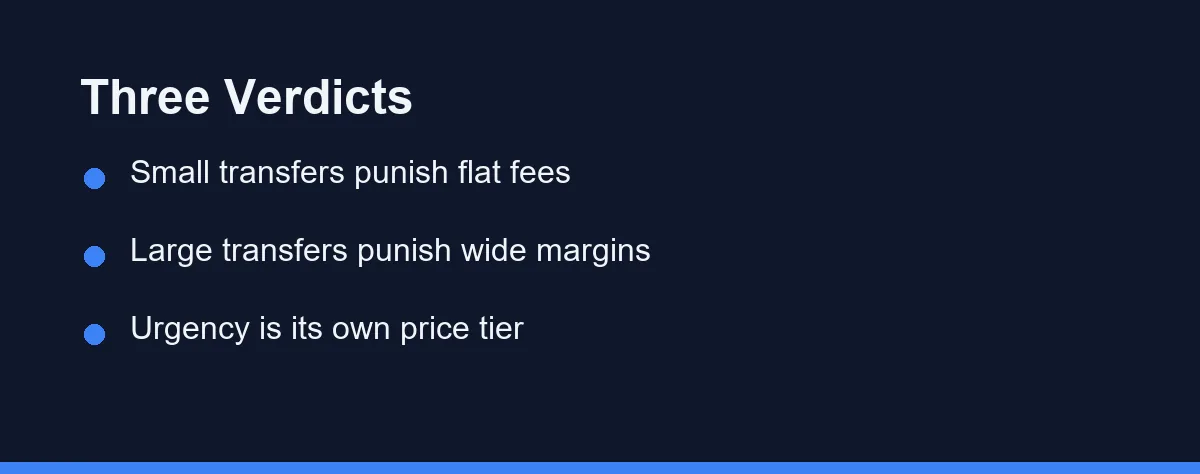
The person sending a small amount monthly: Flat fees hurt most here, so favour providers whose cost scales with the amount. A modest fee on a small transfer is a large percentage.
The person sending a large one-off amount: The rate margin dominates, and the fee is close to irrelevant. Compare the recipient-receives figure across at least three providers before committing.
The freelancer invoicing clients abroad: Look at receiving options rather than sending ones. A local receiving account in the client’s currency avoids conversion until you choose to convert.
The family supporting relatives overseas: Payout method drives the cost more than the provider does. Cash pickup, mobile wallet, and bank deposit frequently carry different rates at the same company.
The traveller spending on cards: Skip transfers entirely and focus on declining dynamic currency conversion. That single habit saves more than most account switching.
The person paying a foreign tuition or property bill: Ask the receiving institution which fee option it expects on the wire. Getting that detail wrong is the usual reason a payment arrives short.
A Five-Minute Comparison Routine
Open a neutral rate source and note the mid-market rate for your pair. This is your reference point, not a rate you expect to receive.
Then collect three quotes for the exact amount and destination, within a few minutes of each other. Write down only what the recipient receives.
Compare those three numbers and ignore every marketing claim on the page. The gap between the best and worst quote is usually larger than people expect, especially on larger amounts.
Sanity-check the winner against the reference rate you noted. Dividing the recipient amount by the amount you send gives your effective rate, and the gap from mid-market is the true total cost as a percentage.
That percentage is the only figure that compares a bank against an app fairly. It folds the fee and the margin into one number, which is what the fee line was designed to obscure.
Repeat the exercise once a year rather than trusting an old conclusion. Providers change their pricing quietly, and the winner from two years ago is not automatically the winner today.
This is general information, not financial advice. Exchange rates, markups, and transfer fees change by the hour, so confirm the total cost with the provider before you send money.
FAQ
What is the mid-market rate, and why does my bank not use it?
The mid-market rate is the midpoint between what buyers and sellers are trading a currency pair at, and it is the rate you see on search engines and financial news sites. Most providers do not give you that rate. They add a margin to it, and that margin is the part that rarely appears as a fee.
How do I compare two transfer quotes fairly?
Compare the amount the recipient actually receives, not the fee. Ask each provider for a quote on the same amount, to the same country, at the same moment, then look only at the final number. That single comparison exposes markups that the fee line hides.
Why did my recipient get less than the amount I was quoted?
Often yes on international wires, because correspondent banks in the middle can deduct their own charges before the money lands. The sending bank may offer a fee option that covers those charges up front. Ask which option applies before you send.
Should I accept when a card terminal abroad offers to charge me in my home currency?
Decline it and pay in the local currency of the country you are in. Dynamic currency conversion lets the merchant's payment processor set the exchange rate, and that rate is almost never better than your card network's.
Are weekend transfers more expensive?
Rates move over the weekend while many providers cannot trade, so some widen their margin to cover the risk. The quote you accept on a Saturday can be worse than the same transfer on a Tuesday. Non-urgent transfers are usually cheaper on a weekday.
Some links may be affiliate links. We may earn a commission at no extra cost to you.
This article was written with AI assistance. It is researched and fact-checked, not based on personal hands-on testing unless explicitly stated.
Comments
Post a Comment