Should Your Emergency Fund Sit at the Same Bank as Checking?
One Tap Away, or Three Days Away
For most people the answer is a split: a small buffer at the everyday bank for same-day bills, and the bulk at a separate, higher-rate institution.
Most advice about emergency funds stops at the amount. Three months of expenses, six months if your income wobbles, and the guidance ends there.
The harder question arrives once the money exists. Should it live beside your checking account, where a transfer clears in seconds, or at a separate bank that pays more and takes days to reach?
Both answers are defensible, and the wrong one shows up at the worst possible moment. This guide works through speed, temptation, insurance limits and the freeze scenario that most plans quietly ignore.
The Trade-off Nobody States Plainly
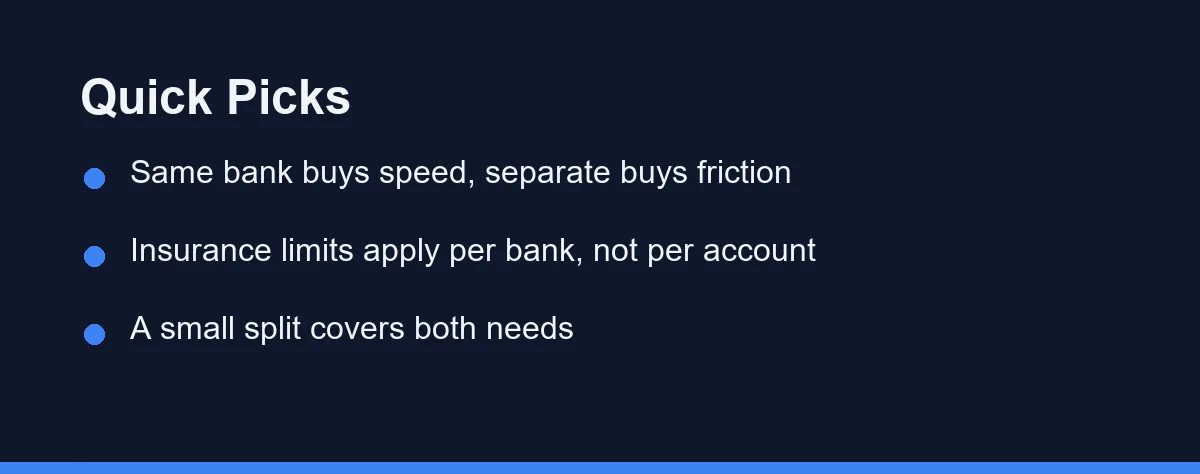
Keeping the fund at your everyday bank buys speed. Internal transfers usually post instantly, so the money behaves almost like checking with a different label.
Keeping it elsewhere buys two things instead. A higher rate, since online banks compete on interest, and a delay that makes casual spending far less likely.
Neither benefit is trivial. The instinct to treat this as a purely mathematical question misses that the fund fails just as easily by being spent as by arriving late.
The practical answer for most households is a split rather than a choice. Speed for the first slice, separation and interest for the rest.
What Same-Bank Access Actually Buys
Speed is the obvious gain, and it is real. Moving cash between accounts at one institution generally completes in seconds, including at night and on weekends.
Overdraft linkage is the underrated one. Many banks let you designate a savings account as backup for checking, which turns an accidental overdraft into a small transfer rather than a fee.
A single app also lowers friction in a genuine crisis. When you are dealing with a hospital, a mechanic or a landlord, one login and one balance is easier to manage.
The costs are equally concrete. Everyday bank savings rates are often a fraction of what online accounts pay, and money sitting in easy reach tends to get borrowed against for things that are not emergencies.
What Separation Actually Buys
The delay is the point. When a purchase requires a transfer that lands two days later, the impulse usually passes before the money does.
Rates are the second reason. Online savings accounts from providers such as Ally, Marcus and SoFi have consistently competed on interest, and rates change often enough that you should confirm current figures on the official site.
Separation also protects against operational failure. If your primary bank has an outage, a card compromise or a lengthy fraud review, a second institution keeps you liquid.
The trade is access. Standard transfers between banks run on the ACH system and typically settle in one to three business days, which is slow when a tow truck is waiting.
Where the Coverage Limit Enters the Picture
Deposit insurance is often misunderstood as a per-account protection. It is not, and that misunderstanding matters most for people who consolidate.
The standard limit is 250,000 dollars per depositor, per insured bank, for each ownership category. Checking and savings at the same bank in your own name generally share that single limit.
Most emergency funds sit far below this, so the point is theoretical for a while. It stops being theoretical if you hold a house deposit, a business reserve or an inheritance in the same place.
The FDIC publishes a calculator that shows exactly how your accounts are covered, and credit union members can check the equivalent share insurance rules for their institution.
Same Bank and Separate Bank, Side by Side

| Factor | Same bank as checking | Separate online bank |
|---|---|---|
| Transfer speed | Seconds to same day | One to three business days |
| Typical interest | Often low | Usually competitive |
| Spending temptation | High, one tap away | Lower, delay applies |
| Overdraft backup | Frequently supported | Rarely supported |
| Outage resilience | Single point of failure | Two independent paths |
| Fraud freeze exposure | Both accounts at once | One institution only |
| Insurance headroom | Shared limit | Separate limit per bank |
| Setup effort | None | One application, one link |
The Freeze Scenario Most Plans Ignore
Account freezes rarely feature in emergency fund advice, and they should. Banks can restrict access during fraud investigations, after suspicious activity, or when identity documents need re-verification.
These reviews usually apply across the customer relationship. A hold triggered by an odd transaction in checking can also lock the savings account beside it.
Card compromise creates a milder version of the same problem. Waiting for a replacement card is tolerable when another bank’s card is in the drawer, and painful when it is not.
The lesson is not that banks are unreliable. It is that a reserve which depends on one login, one card and one institution has a failure mode nobody plans for.
A Split That Covers Both Needs
The hybrid setup solves most of this without complexity. Keep a small buffer at your everyday bank, and hold the main fund at a higher-rate account elsewhere.
Size the buffer around your realistic same-day costs. A vet visit, an insurance excess, a car repair deposit or a plane ticket home is the sort of bill that cannot wait three days.
Everything beyond that belongs where it earns more. The main balance is for rent, groceries and bills during a longer disruption, and those needs arrive on a weekly rather than hourly clock.
Two accounts also make tracking easier, a structure discussed further in our guide on how many savings accounts you should have.
Setting Up the Split Without Locking Yourself Out
The order of operations matters more than the choice of bank. Doing it in the wrong sequence is how people end up with money they cannot reach on the day they need it.
Open the external savings account first, and complete identity verification before moving anything. New accounts often face holds on early deposits, so an unverified account is not yet a reserve.
Link it to your checking account next, usually through small test deposits that take a day or two to appear. This link is what makes future transfers routine rather than urgent.
Then move a small amount in both directions and record how long each leg took. Incoming and outgoing timelines are frequently different, and the outgoing one matters most in a crisis.
Only after that test should the bulk of the fund move across. Fund the everyday-bank buffer at the same time, so there is never a window with the money in transit and nothing at hand.
Finally, name the accounts clearly in both apps and set balance alerts. An account labelled as an emergency fund gets raided less often than one labelled savings, which is a behavioural trick that costs nothing.
The Limits That Surprise People Later
Two rules catch savers out after the accounts are open, and both are worth knowing in advance. Neither is a reason to avoid the split, though each shapes how you use it.
The first is a transfer cap. Many banks limit the size of a single external transfer, and a large withdrawal may need splitting across several days or a wire that carries a fee.
The second is a monthly transaction limit on some savings accounts. Federal rules on withdrawal counts eased in the United States, yet individual banks kept their own caps and fees in place.
Check both numbers on your provider’s official site before deciding where the bulk lives. Confirm whether the account offers a debit card or ATM access as well, since that changes what happens when online banking itself is the thing that fails.
Who Should Keep It Close, and Who Should Not

The right placement depends on your income pattern and your spending habits, not on a universal rule.
Best for people who overspend from savings: A separate bank. If the balance has been raided for non-emergencies before, the transfer delay is doing useful work.
Best for irregular or freelance income: A hybrid split with a larger buffer. Cash flow gaps are frequent and often urgent, so instant access earns its keep.
Best for anyone with an overdraft history: Same bank, at least partly. Linking savings as overdraft backup can prevent repeated fees that dwarf any interest difference.
Best for large balances above the coverage limit: Separate institutions, without exception. Insurance headroom is a hard number, and spreading is the only fix.
Best for households with one earner: Separate bank for the bulk, with both partners holding access. A single frozen relationship should never cut off the whole family.
Best for savers still building the first month of expenses: Same bank for now. Simplicity matters more than rate while the balance is small, an approach outlined in our emergency fund explained guide.
What the Rate Gap Is Worth in Practice
Interest differences deserve honest framing. On modest balances the gap is real money, but it rarely outweighs a fund that fails when you need it.
Rates on high-yield accounts move with wider interest rate conditions, so today’s advantage is not permanent. Confirm current rates on each provider’s official site rather than trusting any figure quoted elsewhere, valid at the time of writing in 2026.
Fees can erase the difference quickly. A single overdraft charge or an out-of-network ATM fee often costs more than a month of extra interest on a starter fund.
Access terms also vary between accounts, including transfer limits and how quickly a new external link becomes usable. Our comparison of high-yield savings and traditional savings covers what changes when you move the money.
Mistakes That Turn a Fund Into a Buffer
The most common error is keeping the entire reserve in checking. Money without a boundary gets spent, and the balance drifts down without any decision ever being made.
The opposite mistake is parking everything at a distant bank without testing it. People discover the three-day timeline during the emergency, which is the worst possible moment to learn it.
Skipping the trial transfer is part of the same problem. Move a small amount both ways when you open the account, and note how long each direction actually takes.
Forgetting the linked-account setup costs real money too. Overdraft backup, alerts and a second debit card take minutes to arrange and only matter when something has already gone wrong.
Finally, plenty of savers chase the top rate every few months. Switching has a cost in attention and transfer delays, and stability is worth more than a small rate improvement on an emergency reserve.
Access Is a Feature, and So Is Friction
There is no single correct home for an emergency fund, because the fund has two jobs that pull in opposite directions. It must be reachable in a crisis, and it must survive the ordinary months when nothing is wrong.
A small buffer at your everyday bank handles the first job. A higher-rate account at a separate institution handles the second, while adding protection against outages and freezes.
Set the buffer at one realistic same-day bill, keep the rest apart, and test the transfer path before you need it. That arrangement beats any argument about which bank pays more this quarter.
For a closer look at where the main balance should sit, see our guide to keeping an emergency fund in a high-yield savings account.
Take this as general education and not financial advice. Transfer times, coverage limits, and fees change and differ by institution, so confirm the current details with your bank before setting up your split.
FAQ
How fast can I move money from savings to checking at the same bank?
Transfers inside one bank usually land instantly or the same day, while transfers between different banks typically take one to three business days. That gap is the main argument for keeping some cash at your everyday bank.
Does keeping everything at one bank affect my FDIC coverage?
Insurance is per depositor, per insured bank, per ownership category, with a standard limit of 250,000 dollars. Splitting money across two banks matters once your total balance at one bank approaches that limit.
Is it harder to spend an emergency fund held at another bank?
Yes, and many people find that helpful. An external account adds a waiting period that discourages impulse withdrawals, which is a feature rather than a flaw for a fund you rarely need.
What if I need cash immediately but my savings are at an online bank?
A hybrid split covers both. Keep roughly one small bill's worth of cash at your everyday bank for instant access, and hold the rest where the interest rate is higher.
Can a bank freeze my savings and checking at the same time?
Fraud reviews and account freezes usually apply at the institution level, so linked accounts can be locked together. Holding your reserve elsewhere means one investigation cannot cut off every dollar you have.
Some links may be affiliate links. We may earn a commission at no extra cost to you.
This article was written with AI assistance. It is researched and fact-checked, not based on personal hands-on testing unless explicitly stated.
Comments
Post a Comment