EE Bonds vs I Bonds: Is the 20-Year Doubling Worth the Wait?
The Answer Turns on Whether You Hold for 20 Years
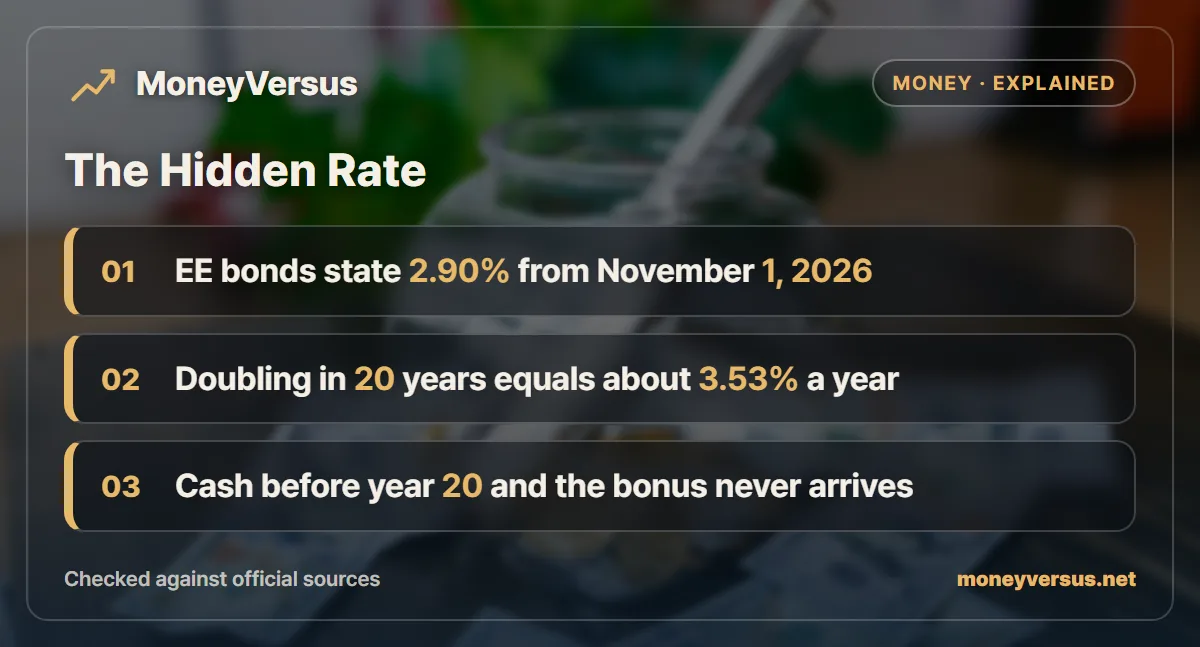
Pick EE bonds only for money you will leave alone for a full 20 years, and I bonds for almost any shorter horizon. TreasuryDirect lists 2.90% for EE bonds and 5.51% for I bonds issued from November 1, 2026 to April 30, 2027. The EE guarantee to double in 20 years works out to about 3.53% a year, but only at the finish line.
Before year 20, an EE bond earns its stated 2.90%, which trails both the I bond and many savings accounts. The doubling is the whole reason to buy one, so the decision comes down to your timeline.
This is general education, not personal financial advice. Rates for new bonds change every six months, so confirm current rates on the official site before buying.
Two Bonds With the Same Rules and Opposite Rates
On paper the two series look almost identical. TreasuryDirect sells both electronically, from $25 up to $10,000, to the penny.
Both earn interest monthly and compound it semiannually. Both lock your money for 12 months, charge the last 3 months of interest if you cash before 5 years, and stop earning after 30 years.
The difference is how the rate works. An EE bond bought now has a fixed rate you know on day one, while an I bond rate can change every 6 months with inflation. That single difference decides which one suits your money.
The Doubling Guarantee Is a 3.53% Rate in Disguise
The TreasuryDirect EE bond page says a new EE bond will double in value in 20 years. That promise matters more than the 2.90% rate printed beside it.
Doubling in 20 years equals about 3.53% a year compounded. At 2.90% compounded semiannually, $10,000 would only grow to about $17,786 by year 20. The guarantee lifts it to $20,000, so roughly $2,214 of the value depends on reaching the 20-year mark.
That creates a cliff. Cash the bond at year 19 and you get the 2.90% path, not the doubled amount. The bond then keeps earning for another 10 years after doubling, up to its 30-year limit.
How the 5.51% I Bond Rate Is Built
The TreasuryDirect I bond page lists a 5.51% composite rate for bonds issued from November 1, 2026 to April 30, 2027. That rate includes a fixed rate of 1.40%, which never changes for the life of the bond.
The other part tracks inflation and resets every 6 months. The page is clear that the rate can go up and can go down. The 5.51% only applies to your first six months, and after that your bond moves to whatever inflation reading comes next.
So the honest way to read an I bond is as a 1.40% fixed rate plus an inflation adjustment. If inflation stays high, it beats the EE guarantee easily. If inflation fades, it can end up below it.
EE and I Bonds on Every Term That Matters
The table uses the TreasuryDirect EE, I bond and comparison pages, checked October 31, 2026.
| Term | Series EE | Series I |
|---|---|---|
| Rate for bonds issued Nov 1, 2026 to Apr 30, 2027 | 2.90% | 5.51% composite |
| How long the rate holds | At least 20 years | 6 months, then resets |
| Fixed part | Whole rate is fixed | 1.40% for life |
| Built-in guarantee | Doubles in 20 years | None tied to a target value |
| Purchase range | $25 to $10,000 | $25 to $10,000 |
| Yearly limit per SSN | $10,000 electronic | $10,000 electronic |
| Earliest cash-out | 12 months | 12 months |
| Penalty before 5 years | Last 3 months of interest | Last 3 months of interest |
| Interest stops | 30 years | 30 years |
| State and local income tax | Exempt | Exempt |
Every row matches except the first four. That makes this one of the rare comparisons where the only real variable is how long you hold.
Running $10,000 Through Both Bonds
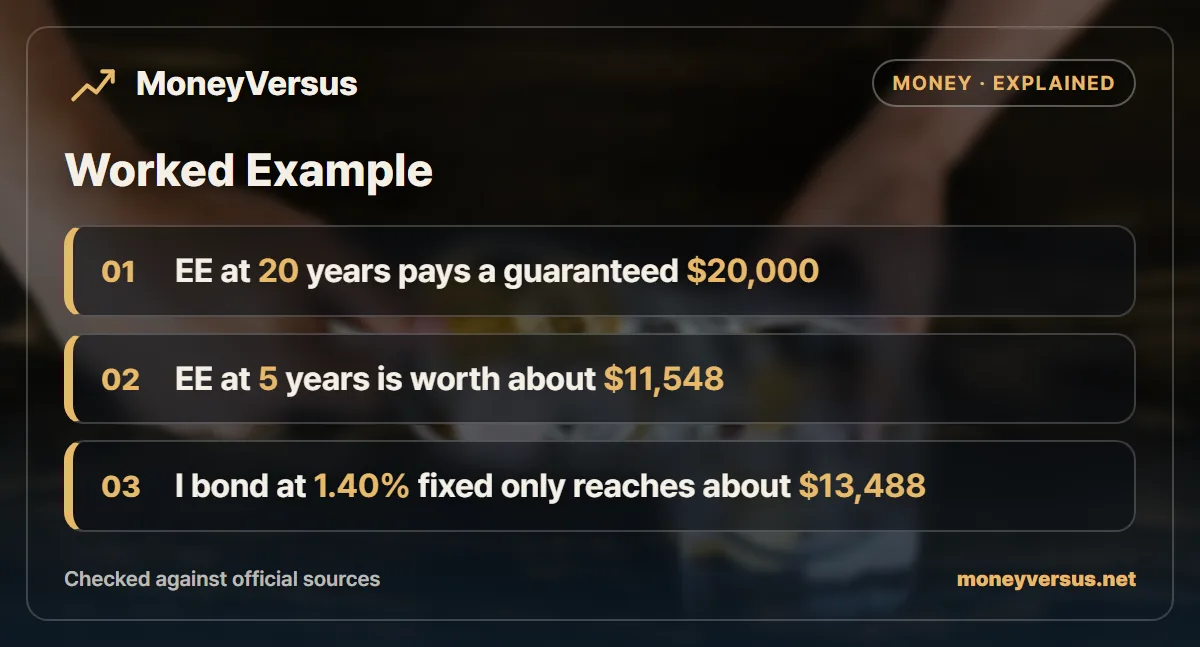
Here is $10,000 bought in November 2026 in each series. EE figures use 2.90% compounded every six months, and I bond figures show two paths because the future rate is unknown.
The I bond lines assume the first six months at 5.51%. The low path assumes the inflation part then falls to zero, leaving the 1.40% fixed rate. The high path assumes 5.51% holds the whole time, which is unlikely.
| Holding period | EE bond | I bond, low path at 1.40% | I bond, high path at 5.51% |
|---|---|---|---|
| 5 years | About $11,548 | About $10,941 | About $13,123 |
| 20 years | $20,000 guaranteed | About $13,488 | About $29,656 |
These figures ignore TreasuryDirect rounding and assume no early cash-out. At 5 years the EE bond beats the low I bond path by about $607, but loses to the high path by about $1,575.
At 20 years the gap widens in both directions. For the I bond to match the EE guarantee, its composite rate would need to average about 3.5% across all 20 years. The example shows that EE wins only when you expect modest inflation and know you will hold to the end.
What Cashing Out Early Does to Each One
Both bonds lose the last 3 months of interest if cashed before year 5. On a $10,000 EE bond cashed at 12 months, that leaves roughly 9 months of interest, or about $218.
The bigger early-exit cost belongs to EE alone. Any EE bond cashed before year 20, even with no penalty after year 5, forfeits the doubling. At year 15 it is worth about $15,401 instead of the $20,000 waiting five years later.
An I bond has no such cliff. Its value at year 15 is whatever its rates produced, so leaving early costs you only the future interest you skip.
Old Paper EE Bonds Play by Their Own Calendar
Many people meet EE bonds as paper certificates from a relative. TreasuryDirect says paper EE bonds were issued from 1980 through 2012, and Patriot Bonds, a kind of EE bond, were sold from 2001 through 2011.
The same 30-year earning limit applies to them. A paper bond issued in 1996 reaches 30 years during 2026 and stops earning. Every bond from 1980 through 1996 is in the same position by the end of this year.
A bond that has stopped earning only loses ground to inflation while it sits in a drawer. Cashing it and moving the money somewhere that pays interest is usually the better move.
Bonds issued since May 2005 earn their set rate for the first 20 years. Check the issue date on any paper bond before deciding whether to hold it, because the answer depends on how many earning years remain.
Taxes and the Education Exclusion Apply to Both
Interest on either series is subject to federal income tax but exempt from state and local income tax. You can report it each year or wait until you cash the bond, which can push the bill decades out.
Both series can also be tax-free for education under the IRS exclusion. TreasuryDirect lists the conditions on its higher education page. The owner must have been 24 or older when the bond was issued, and modified AGI must be under the IRS cut-off for that year.
You must cash the bonds and pay qualified expenses in the same tax year. The expenses must be for you, your spouse or a dependent, and you cannot file married filing separately. A bond registered in a child’s name as owner does not qualify.
The Parent Saving for College Is the EE Use Case
A parent who buys an EE bond when a child is born holds it about 18 years before college. That is short of the 20-year doubling, which weakens the EE case for a newborn.
The fit is better for a parent buying when the child is a toddler, or a grandparent planning around a fixed date. If the bond can reach 20 years before tuition is due, the guaranteed doubling plus a possible education exclusion is hard to beat with a government-backed product.
For goals that land in 10 or 15 years, the I bond usually works better because there is no cliff to miss. Our guide to Treasury bills vs CDs covers shorter dated money.
Which Savings Bond Fits Your Timeline
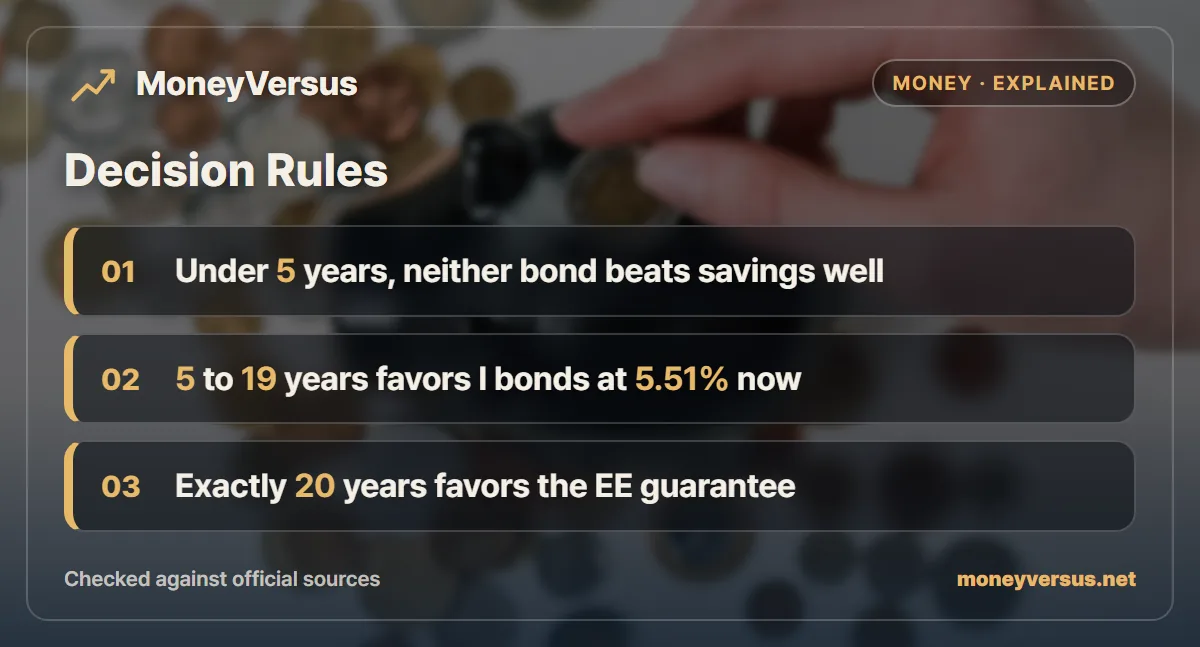
If you might need the money within 5 years: Neither bond is ideal. The 12-month lock and 3-month penalty eat into returns, and our comparison of I bonds vs a high-yield savings account shows how small the edge gets.
If you can hold 5 to 19 years: I bonds fit better. You start at 5.51% with a 1.40% fixed rate for life, and you never risk missing a doubling date.
If you will hold exactly 20 years or more: EE bonds fit. The guarantee locks in about 3.53% a year, which beats the I bond unless its composite rate averages above about 3.5%.
If you have more than $10,000 to place each year: Buy both. The limits are separate, so one person can put $10,000 in each series per calendar year.
Using Both Limits Without Overthinking It
Many long-term savers split the difference. EE bonds become the 20-year anchor with a known endpoint, and I bonds become the inflation hedge you can cash after five years without regret.
Before buying either, fund your emergency cushion somewhere reachable. Our guide to keeping an emergency fund in high-yield savings explains why a 12-month lock does not belong there.
Then write down the year you expect to need the money. If that year is at least 20 away, EE earns its place, and if it is closer, the I bond is the simpler choice.
FAQ
What are the current EE and I bond rates?
For bonds issued from November 1, 2026 to April 30, 2027, TreasuryDirect lists 2.90% for EE bonds and 5.51% for I bonds. The EE rate stays the same for at least 20 years, while the I bond rate holds for 6 months and includes a 1.40% fixed rate that never changes.
Do EE bonds really double in 20 years?
TreasuryDirect guarantees that a new EE bond will double in value in 20 years. Doubling in 20 years works out to about 3.53% a year compounded, which is higher than the stated 2.90% rate. The extra only arrives if you hold the bond to the 20-year mark, so cashing earlier leaves you with the lower rate.
Can you buy both EE and I bonds in the same year?
Yes. The $10,000 limit applies to each series separately, per Social Security number per calendar year. One person can buy up to $10,000 in electronic EE bonds and another $10,000 in electronic I bonds in the same year, for $20,000 in total.
What happens if you cash an EE or I bond early?
Both follow the same rules. You cannot cash either bond for 12 months, and if you cash it before 5 years you lose the last 3 months of interest. After 5 years there is no penalty, and both keep earning interest for up to 30 years.
Are EE and I bonds taxed the same way?
Interest on both is subject to federal income tax but exempt from state and local income tax. You can report it each year or wait until you cash the bond. Either series can also qualify for the education exclusion if the owner was 24 or older when the bond was issued and the other IRS conditions are met.
Sources
- TreasuryDirect: EE bonds — checked 2026-10-31
- TreasuryDirect: I bonds — checked 2026-10-31
- TreasuryDirect: Comparing EE and I bonds — checked 2026-10-31
- TreasuryDirect: Using savings bonds for higher education — checked 2026-10-31
Some links may be affiliate links. We may earn a commission at no extra cost to you.
How this article was made: it was drafted with AI assistance from the official sources listed above, and its figures were checked against those pages on the dates shown. It is not based on personal hands-on testing.
Comments
Post a Comment