SEP IRA vs Solo 401(k) for Freelancers: Which Lets You Save More

A Solo 401(k) Wins for Most One-Person Businesses
Pick the solo 401(k) if you work alone and want to save more than 20% of your earnings. Below $360,000 of net earnings it allows more than a SEP, unless a day job 401(k) already uses your deferral. Both plans share the same $72,000 total cap for 2026, per the IRS. The difference is the employee deferral of up to $24,500 that only the 401(k) offers.
A SEP IRA still makes sense when you have eligible employees, want the least paperwork, or are deciding after the tax year has already ended. The rest of this guide shows where each of those cases applies.
Why Two Plans With the Same Cap Give Different Answers
The headline numbers make the plans look identical. Each lets a self-employed person contribute up to $72,000 in 2026, and each is open to a business of any size.
What differs is how you reach that cap. A SEP has one bucket, the employer contribution. A solo 401(k) has two, because the IRS describes the owner as wearing two hats, employee and employer.
The employer bucket is the same size in both plans. The employee bucket is the extra room, and it matters most when your income is modest.
How the 20% Employer Contribution Is Calculated
The IRS says a SEP contribution cannot exceed 25% of compensation. For a self-employed owner, compensation is not your gross revenue or your net profit.
You start from net profit on Schedule C and subtract the deduction for half of your self-employment tax. Publication 560 then applies a reduced rate, and its rate table converts a 25% plan rate into 20% for the self-employed.
The publication gives an example of the first step. A sole proprietor with $200,000 of net profit and a $13,596 deduction for half of self-employment tax has $186,404 of net earnings. At 20%, the employer contribution on that amount would be $37,280.80.
The same 20% applies to the employer share in a solo 401(k). The plan rules differ only in what you can add on top.
The Two Accounts Line by Line

These are the 2026 figures and rules from IRS pages checked in October 2026. Confirm current limits on the official IRS site before you contribute.
| Feature | SEP IRA | Solo 401(k) |
|---|---|---|
| Total contribution cap, 2026 | $72,000 | $72,000, or $80,000 with the age 50 catch-up |
| Employer contribution | Up to 25% of pay, 20% of net earnings when self-employed | Same 25% and 20% rule |
| Employee deferral, 2026 | Not permitted | Up to $24,500 |
| Catch-up at age 50 and over | Not permitted | $8,000, or $11,250 at ages 60 to 63 |
| Compensation counted, 2026 | Up to $360,000 | Up to $360,000 |
| Who it covers | You plus eligible employees | You, or you and your spouse |
| Setup deadline | Tax return due date, with extensions | Stricter first-year rules for owner deferrals |
The deferral and catch-up rows are where the money is. The coverage row is where the decision often gets made for you.
Five Income Levels Run Through Both Plans

These figures assume net earnings after the deduction for half of self-employment tax, a 20% employer rate, and a contributor under age 50. Arithmetic uses the 2026 limits above.
| Net earnings | SEP IRA maximum | Solo 401(k) maximum | Difference |
|---|---|---|---|
| $40,000 | $8,000 | $32,500 | $24,500 |
| $80,000 | $16,000 | $40,500 | $24,500 |
| $150,000 | $30,000 | $54,500 | $24,500 |
| $237,500 | $47,500 | $72,000 | $24,500 |
| $360,000 | $72,000 | $72,000 | $0 |
The solo 401(k) column adds the $24,500 deferral to the same 20% employer share. It reaches the $72,000 cap at $237,500 of net earnings, while the SEP needs $360,000 to get there.
At $40,000 the deferral also has to fit inside your compensation. Elective deferrals are capped at 100% of compensation, and $32,000 is left after the $8,000 employer share, so the full $24,500 still fits.
Add age to the picture and the gap widens. A 55-year-old earning $360,000 can reach $80,000 in a solo 401(k) with the catch-up, while the SEP stays at $72,000.
When the SEP Is the Better Choice
The extra room only helps if you would use it. If you plan to save around $8,000 on $40,000 of earnings, both plans accept that, and the SEP is easier to run.
Employees change the comparison completely. The IRS says a SEP must include employees who are 21 or older, have worked for you in 3 of the last 5 years, and earned at least $800 in 2026.
Most SEPs, including the IRS model Form 5305-SEP, require contributions proportional to pay. If you put in 20% for yourself, each eligible employee gets 20% too.
The SEP is also flexible from year to year. The IRS states that you are not required to contribute every year, which suits income that swings with clients.
Freelancing on the Side of a Salaried Job
Many people open one of these plans for side income while a day job already offers a 401(k). Two IRS rules then pull in opposite directions.
The first rule limits the employee deferral. The IRS says you aggregate all elective deferrals you make to every plan you participate in, and compare the total with the yearly cap of $24,500 in 2026.
If you already defer $24,500 at work, a solo 401(k) gives you no extra deferral room. Only the employer share remains, which is the same 20% a SEP would allow.
The second rule works in your favor. The IRS explains that the limit on annual additions applies to each plan separately, so deferrals at your day job do not shrink the employer contribution to your own plan.
In that situation the gap between the two plans can disappear. A SEP may then be the simpler way to shelter side income, because the 401(k) has nothing extra to offer.
If you defer less at work, the solo 401(k) can absorb the unused part of the $24,500. Track the combined total yourself, since neither employer sees the other plan.
Deadlines That Can Decide It for You
Timing is where many freelancers end up choosing by default. The IRS allows a SEP to be set up as late as the due date of your tax return, including extensions, and contributions to count by that date too.
A 401(k) is less forgiving for the first year. Publication 560 ties first-year owner deferrals for a sole proprietor with no employees to the filing deadline without extensions.
If it is already spring and you have not opened anything, a SEP may be the only plan that still works for last year. Opening a solo 401(k) early in the current year leaves you free to choose the bigger plan next time.
Paperwork Once the Balance Grows
The IRS says a one-participant 401(k) generally must file Form 5500-EZ once it holds $250,000 or more at the end of the year. Below that, the annual filing may not apply.
That filing is a reason to keep a calendar note, not a reason to skip the plan. On $80,000 of earnings, the extra $24,500 a year usually outweighs one more form.
Taxes still come first in a freelancer budget. If you are unsure how much of each payment to hold back before retirement saving, start with how much of every freelance payment should go to taxes.
Which Account Fits Your Business Today
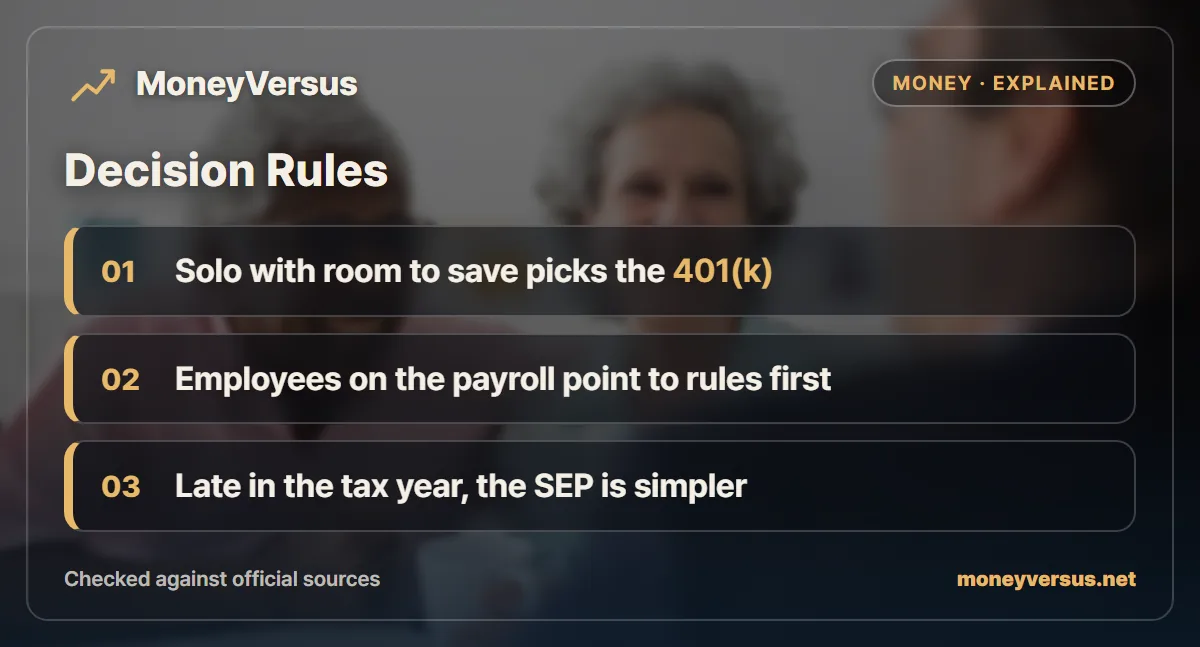
If you work alone and want to save more than 20% of net earnings: The solo 401(k) fits. The $24,500 deferral is room a SEP cannot give you.
If you have, or will soon have, eligible employees: Read the SEP coverage rules before deciding. A one-participant 401(k) by definition covers only the owner and spouse.
If it is already past the end of the tax year: The SEP fits for that year. Open a solo 401(k) early in the new year if you want the larger limit going forward.
If you are 50 or older and earn well: The solo 401(k) fits, because the $8,000 catch-up and the $11,250 version at ages 60 to 63 are unavailable in a SEP.
If you also have a day job with a 401(k): The IRS adds up your elective deferrals across every plan, so the extra room may be smaller. Our guide to funding a Roth IRA or a 401(k) first covers the order of accounts.
Pick the Account You Will Actually Fund
Run your own net earnings through the table above before opening anything. If the SEP maximum already covers what you plan to save, its simplicity is worth more than room you will not use.
If your income is high enough to hit Roth IRA limits, a retirement plan through the business becomes even more useful. See what happens if you earn too much for a Roth IRA for the options that remain.
Confirm current limits on the IRS SEP contribution limits page and the IRS one-participant 401(k) page before contributing. A tax professional can check your net earnings figure, which drives every number here.
FAQ
Can you put more in a SEP IRA or a solo 401(k)?
At the same income, usually the solo 401(k). Both allow an employer contribution worth about 20% of net self-employment earnings, but the solo 401(k) adds an employee deferral of up to $24,500 in 2026. The two only meet at the $72,000 cap, which a SEP reaches at $360,000 of net earnings.
How much can a self-employed person put in a SEP IRA in 2026?
The IRS lists $72,000 for 2026 as the dollar cap for a SEP, and the contribution cannot exceed 25% of compensation. For a self-employed owner, the IRS rate table turns that 25% into 20% of net earnings after the deduction for half of self-employment tax.
Does a SEP IRA allow catch-up contributions after age 50?
No. The IRS says elective deferrals and catch-up contributions are not permitted in SEP plans. A solo 401(k) allows the $8,000 catch-up for ages 50 and over in 2026, or $11,250 for ages 60 to 63.
Is it too late to open a SEP IRA or solo 401(k) for last year?
A SEP can be set up as late as the due date of your tax return, including extensions, and funded by that date too. A new 401(k) has stricter first-year rules for owner deferrals, so read the Publication 560 section on timing before you wait until spring.
When does a solo 401(k) have to file Form 5500-EZ?
Generally once the plan holds $250,000 or more at the end of the year, according to the IRS page on one-participant plans. Below that level the annual Form 5500-EZ filing may not be required. The threshold is a reason to track the balance, not to avoid the plan.
Sources
- IRS: SEP contribution limits, including grandfathered SARSEPs — checked 2026-10-30
- IRS: COLA increases for dollar limitations on benefits and contributions — checked 2026-10-30
- IRS: One-participant 401(k) plans — checked 2026-10-30
- IRS Publication 560: Retirement Plans for Small Business — checked 2026-10-30
- IRS: Retirement plans FAQs regarding SEPs — checked 2026-10-30
Some links may be affiliate links. We may earn a commission at no extra cost to you.
How this article was made: it was drafted with AI assistance from the official sources listed above, and its figures were checked against those pages on the dates shown. It is not based on personal hands-on testing.
Comments
Post a Comment