Charity Deduction Without Itemizing: What the New 2026 Cash Limit Is Worth

Cash Gifts Now Count Even With the Standard Deduction

For tax year 2026, you can deduct up to $1,000 of cash gifts to charity without itemizing, or $2,000 on a joint return. For a couple in the 12% bracket, the full $2,000 is worth $240 off the federal tax bill.
The deduction sits on top of the standard deduction, so most households who never itemize can now get something back for giving. It only covers cash, and only gifts made during 2026.
Itemizers face a change in the other direction. From 2026, the first 0.5% of AGI in charitable gifts is not deductible at all.
What the IRS Confirmed on November 10
The IRS repeated the rules in release IR-2026-135 on November 10, 2026. It calls the deduction permanent and says it first appears on returns filed in 2027.
The gifts must be cash to a qualified charitable organization. Checks, card payments and bank transfers all count as cash for this purpose.
Three kinds of gifts are left out. Noncash gifts, cash to supporting organizations, and cash used to set up or maintain a donor-advised fund do not qualify.
The Two 2026 Charity Rules Side by Side
The non-itemizer deduction and the itemizer floor arrived in the same law. They pull in opposite directions, so it helps to see them together.
| Rule for 2026 | If you take the standard deduction | If you itemize |
|---|---|---|
| Cash gifts deductible | Up to $1,000, or $2,000 joint | Amount above 0.5% of AGI |
| Standard deduction | $16,100 single, $32,200 joint | Not taken |
| Gifts of stock or goods | Not deductible | Deductible under the usual rules |
| Donor-advised fund gifts | Not deductible | Deductible under the usual rules |
| Supporting organization gifts | Not deductible | Deductible under the usual rules |
| Value on $1,800 of giving at 12% | $216 | Depends on whether you clear the standard deduction |
The standard deduction figures come from IRS release IR-2025-103. Heads of household get $24,150.
IRS Publication 505 confirms the floor in plain terms. Amounts under the 0.5% floor cannot be deducted in 2026.
Gifts That Do Not Qualify Without Itemizing
The cash-only rule catches more people than the cap. A bag of clothes to a thrift store has no deduction at all unless you itemize.
Gifts of appreciated stock work the same way. They remain a strong tool for itemizers, but they earn nothing under the new non-itemizer deduction.
Donor-advised funds are the other gap. Cash moved into a fund at a brokerage does not count, even though the fund later grants it to charities.
Give directly to the charity if you want the gift to count. A check or online payment to the organization itself is the cleanest route.
Five Givers Run the 2026 Numbers

These are illustrations with assumed figures. None of these households itemizes, each has only wage income, and none claims other credits that use up its tax.
Couple A files jointly with $90,000 of AGI and gives $1,800 in cash. That is $25 a week at church and a $500 year-end gift to a food bank.
Before 2026 those gifts would have done nothing on their return. Now taxable income drops from $57,800 to $56,000, all inside the 12% bracket, so their tax falls by $216.
Couple B has the same income but gives $3,000 in cash. Only $2,000 counts, so the deduction saves $240. The extra $1,000 earns no tax benefit at all.
A single teacher has $48,000 of AGI and gives $1,000 in cash. After the $16,100 standard deduction, a taxable income of $31,900 sits in the 12% bracket, so the gift saves $120.
Couple D looks like Couple A on paper but gives $2,000 of shares from a brokerage account. Shares are a noncash gift, so their deduction without itemizing is zero.
Couple E moves $2,000 of cash into a donor-advised fund in December. The IRS excludes that too, even if the fund grants every dollar to a charity in 2027.
| Giver | Filing status and AGI | What they gave | Amount counted | Federal tax saved |
|---|---|---|---|---|
| Couple A | Joint, $90,000 | $1,800 cash | $1,800 | $216 |
| Couple B | Joint, $90,000 | $3,000 cash | $2,000 | $240 |
| Single teacher | Single, $48,000 | $1,000 cash | $1,000 | $120 |
| Couple D | Joint, $90,000 | $2,000 of shares | $0 | $0 |
| Couple E | Joint, $90,000 | $2,000 into a donor-advised fund | $0 | $0 |
Couples D and E gave as much as Couple B and got nothing back. The form of the gift, not its size, made the $240 difference.
The cap also sets a natural budget. Above $2,000 of cash on a joint return, each extra dollar is pure generosity unless your other deductions make itemizing worthwhile.
When Itemizing Still Beats the Cash Deduction
The cash deduction only helps on returns that take the standard deduction. If mortgage interest, state taxes and gifts add up to more than the standard deduction plus $2,000, itemizing still wins.
Itemizers lose the first 0.5% of AGI in gifts, though. At $100,000 of AGI that is $500, and at $300,000 it is $1,500.
Our guide on whether to itemize or take the standard deduction runs three households through that comparison. It also covers bunching several years of gifts into one itemized year.
Records That Keep the Deduction Safe
The IRS asks you to keep a receipt, canceled check, bank record or written note from the charity. It must show the organization name, the date and the amount.
IRS Topic 506 adds a stricter rule for larger gifts. Any single contribution of $250 or more needs a written acknowledgment from the charity.
If you get something back, such as a dinner or a tote bag, you can deduct only the amount above its fair market value. The charity usually states that value on the receipt.
Weekly cash in a collection plate is the weak spot. Use envelopes the church records, or give by check or app, so a bank record exists.
Common Mistakes With the New Deduction
Counting the thrift-store bag. Noncash gifts do not qualify unless you itemize, however generous the donation was.
Routing gifts through a donor-advised fund. Cash into the fund does not count for the non-itemizer deduction, even if every dollar later reaches a charity.
Assuming each spouse gets $2,000. The joint return limit is $2,000 in total, and a single filer gets $1,000.
Giving to a person, not an organization. A GoFundMe for a neighbor is generous, but gifts to individuals are not charitable deductions.
Waiting until 2027 to pay a 2026 pledge. Only cash given during 2026 counts on the 2026 return.
Which Giving Approach Fits Your Household
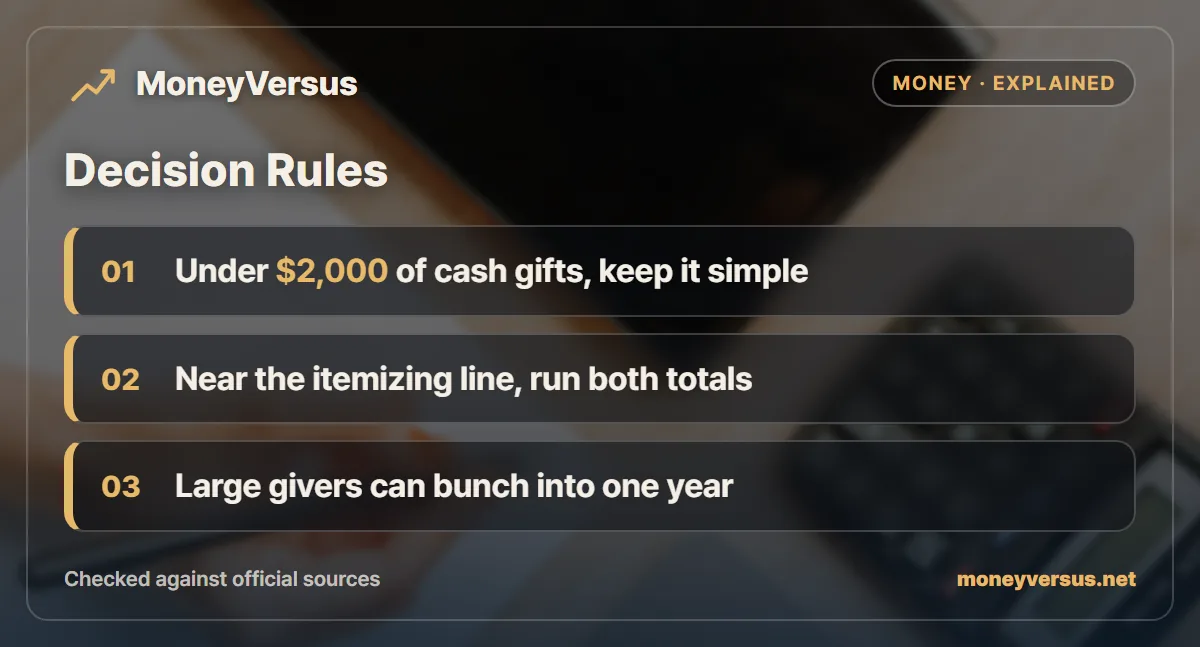
Start by adding up your cash gifts so far this year. Then compare your other itemized deductions with the standard deduction.
You give under $2,000 a year and never itemize: Do nothing new except keep records. The deduction now applies on its own when you file.
You give well over $2,000 and never itemize: Consider whether bunching two or three years of gifts would push you over the standard deduction in one year.
You sit within a few thousand dollars of the itemizing line: Run both totals. The extra $2,000 on the standard side can erase most of the gap.
You give stock or use a donor-advised fund: Keep doing it in years you itemize. In standard-deduction years, switch to direct cash gifts if you want a deduction.
You have a high income and give modestly: Expect the 0.5% floor to cut your deduction noticeably. Concentrating gifts into fewer years softens it.
A Six-Week Checklist Before December 31
There is still time to shape 2026 giving. Work through these steps before the last week of December.
- Step 1: Total your 2026 cash gifts from bank and card statements.
- Step 2: Estimate your itemized deductions, including mortgage interest and state taxes.
- Step 3: Compare that total with your standard deduction plus up to $2,000 of cash gifts.
- Step 4: If itemizing wins, subtract 0.5% of AGI from your charity total first.
- Step 5: Decide whether to move a planned January gift into December, or the other way round.
- Step 6: Request written acknowledgments for any gift of $250 or more.
Year-end giving also interacts with other tax moves. If you have side income, our guide to how much freelance income to set aside for taxes helps size the bill before you decide what to give.
If you file your own return, the software choice matters for small deductions. Our comparison of IRS Free File and paid tax software shows which options handle this kind of entry.
What These Figures Cover
The limits and rules here are IRS figures for tax year 2026, read on November 12, 2026. They come from IR-2026-135, Topic 506, Publication 505 and IR-2025-103.
This is general information, not personal tax advice. The examples leave out state taxes and other credits, so confirm your own numbers with tax software or a professional.
Givers aged 70 1/2 or older have a second route that the $2,000 cap does not touch. Our guide to giving from your IRA instead of your checking account works out how much more a direct IRA gift saves.
FAQ
Can you deduct charity without itemizing in 2026?
Starting with tax year 2026, people who do not itemize can deduct up to $1,000 of qualifying cash gifts to charity, or $2,000 on a joint return. The IRS describes the deduction as permanent.
Do donations to a donor-advised fund count for the non-itemizer deduction?
No. The IRS excludes noncash gifts such as clothing or stock, cash given to supporting organizations, and cash used to set up or add to a donor-advised fund.
What is the 0.5% floor on charitable deductions?
Only the part of your 2026 charitable gifts above 0.5% of your AGI is deductible when you itemize. A couple with $150,000 of AGI loses the first $750 of giving.
If I give $5,000 in cash, can I deduct all of it without itemizing?
No. The deduction is capped at $1,000 for single filers and $2,000 for joint filers, so giving beyond that earns no extra deduction unless itemizing beats the standard deduction.
What records do I need for the new charity deduction?
Keep a bank record, receipt or written note from the charity showing its name, the date and the amount. Any single gift of $250 or more also needs a written acknowledgment from the charity.
Sources
- IRS reminder: Permanent charitable contribution deduction begins for returns filed next year for taxpayers who do not itemize (IR-2026-135) — checked 2026-11-12
- IRS Topic 506: Charitable contributions — checked 2026-11-12
- IRS Publication 505 (2026): Tax Withholding and Estimated Tax — checked 2026-11-12
- IRS: Tax inflation adjustments for tax year 2026 (IR-2025-103) — checked 2026-11-12
Some links may be affiliate links. We may earn a commission at no extra cost to you.
How this article was made: it was drafted with AI assistance from the official sources listed above, and its figures were checked against those pages on the dates shown. It is not based on personal hands-on testing.
Comments
Post a Comment