HSA Last-Month Rule: When a Late Start Still Allows the Full Limit
December 1 Coverage Can Unlock the Full HSA Limit

If you have HDHP coverage on December 1, 2026, you can usually contribute the full 2026 HSA limit. That is $4,400 for self-only coverage or $8,750 for family coverage, even if your plan started in the fall.
The catch is a testing period. You must stay HSA-eligible through December 31, 2027.
If you do not, the extra amount the rule allowed becomes taxable income, plus a 10% additional tax. The rule rewards people who expect to keep their plan, and it penalizes those who switch soon.
Two Ways to Figure a Partial-Year Limit
IRS Publication 969 for 2025 returns describes both methods. You choose one when you decide how much to contribute.
Proration. Publication 969 points to a month-by-month chart in the Form 8889 instructions. In its examples, each month you are eligible on the first day is worth one-twelfth of the annual limit.
The last-month rule. If you are an eligible individual on the first day of the last month of your tax year, you are treated as eligible for the entire year. For most people, that day is December 1.
Under that rule, you use the full-year limit for the coverage you hold in December. The price is the testing period that follows.
The 2026 Limits and Plan Rules
Publication 969 lists the 2026 figures alongside the 2025 ones. Your plan must meet the HDHP rules for the year, not just carry a high-deductible label.
| Item for 2026 | Self-only coverage | Family coverage |
|---|---|---|
| HSA contribution limit | $4,400 | $8,750 |
| Extra catch-up at age 55 or older | $1,000 | $1,000 |
| Minimum annual deductible | $1,700 | $3,400 |
| Maximum deductible and out-of-pocket | $8,500 | $17,000 |
| 2025 contribution limit, for comparison | $4,300 | $8,550 |
| Testing period for 2026 contributions | Dec 1, 2026 to Dec 31, 2027 | Dec 1, 2026 to Dec 31, 2027 |
The catch-up applies if you are 55 or older at the end of the year. It raises the limit by $1,000 under either method.
What the Testing Period Requires
The testing period starts with the last month of the tax year. It ends on the last day of the 12th month after that month.
For 2026 contributions, that runs from December 1, 2026, to December 31, 2027. You must remain an eligible individual for that whole stretch, which is 13 months.
Eligibility means more than having an HDHP. Publication 969 also drops your limit to zero from the first month you are enrolled in Medicare.
Two causes do not count as failures. Publication 969 excludes failures caused by death or disability.
What Failing the Test Costs
If you fail, the amount you contributed only because of the last-month rule is added to your income. It is included in the year you lose eligibility, not the year you contributed.
That amount also owes a 10% additional tax. You figure both on Form 8889, Part III.
Publication 969 gives its own example. A 53-year-old becomes eligible on December 1, 2025, with family coverage and contributes $8,550.
That person loses eligibility in June 2026. One month of eligibility was worth $712.50, so $7,837.50 goes into 2026 income, with the 10% additional tax on top.
A September Start Run Both Ways

These are illustrations with assumed numbers. A 40-year-old single filer joins a self-only HDHP on September 1, 2026, and expects 2026 taxable income of $70,000.
She is eligible on the first day of September, October, November and December. That is four months under proration.
| Step | Prorate | Last-month rule |
|---|---|---|
| Months counted | 4 | Treated as 12 |
| 2026 contribution allowed | $1,466.67 | $4,400.00 |
| Extra deduction from the rule | $0 | $2,933.33 |
| Federal tax saved at 22% | $322.67 | $968.00 |
| Added to 2027 income if she fails | $0 | $2,933.33 |
| Tax and 10% charge if she fails | $0 | $938.66 |
The 22% rate comes from the 2026 brackets in IRS release IR-2025-103. Single taxable income between $50,400 and $105,700 falls in that band.
If she keeps her HDHP through 2027, the rule earns her $645.33 more in tax savings for 2026. The money can also stay invested in the HSA.
If she changes jobs in June 2027 and loses HDHP coverage, $2,933.33 goes into her 2027 income. At 22%, that is $645.33 of tax, plus a $293.33 additional tax.
So failing hands back the whole extra saving and costs $293.33 more. That gap assumes her rate stays at 22% in 2027.
Family Coverage Doubles the Stakes
The same September start looks different with family coverage. The 2026 family limit is $8,750, roughly twice the self-only figure.
Assume a married couple filing jointly moves to a family HDHP on September 1, 2026. Their 2026 taxable income is $150,000, which IR-2025-103 places in the 22% band for joint filers.
| Step | Prorate | Last-month rule |
|---|---|---|
| 2026 contribution allowed | $2,916.67 | $8,750.00 |
| Extra deduction from the rule | $0 | $5,833.33 |
| Extra federal tax saved at 22% | $0 | $1,283.33 |
| 10% additional tax if they fail | $0 | $583.33 |
| Net cost of failing, before growth | $0 | $583.33 |
If they keep the plan through 2027, the rule saves them $1,283.33 more in federal tax. If one spouse’s job change ends the family HDHP in 2027, they repay that saving and owe $583.33 on top.
A larger extra deduction means a larger penalty base. Families with an uncertain job outlook have more to lose than single savers.
What the Rule Does Not Change
The last-month rule only changes how many months count. It does not loosen the other conditions in Publication 969.
Your December plan still has to meet the 2026 HDHP minimum deductible of $1,700 for self-only or $3,400 for family coverage. A plan below those figures does not qualify, whatever its name.
The Medicare rule also stays in force. If you enroll in Medicare during 2026, your limit is zero from that month, and you cannot use the rule.
The rule also does not raise the annual limit itself. It only lets you use the full figure for a partial year.
When the Rule Backfires
The testing period is long enough to catch plans that change. These are the common ways people fail it.
A job change. A new employer may offer only a plan that is not an HDHP. Coverage under that plan can end your eligibility.
Medicare enrollment. Your limit drops to zero from your first Medicare month. Publication 969 says this also applies when Medicare coverage is retroactive.
A plan redesign. An employer can lower the deductible below $1,700 for self-only coverage. The plan then stops qualifying as an HDHP.
Adding other health coverage. Some coverage beyond the HDHP can end eligibility. Check with your plan before adding a spouse’s general plan.
Which Contribution Amount Fits Your Next 13 Months
Start by asking whether you will keep HDHP coverage through December 31, 2027. Your answer picks the method.
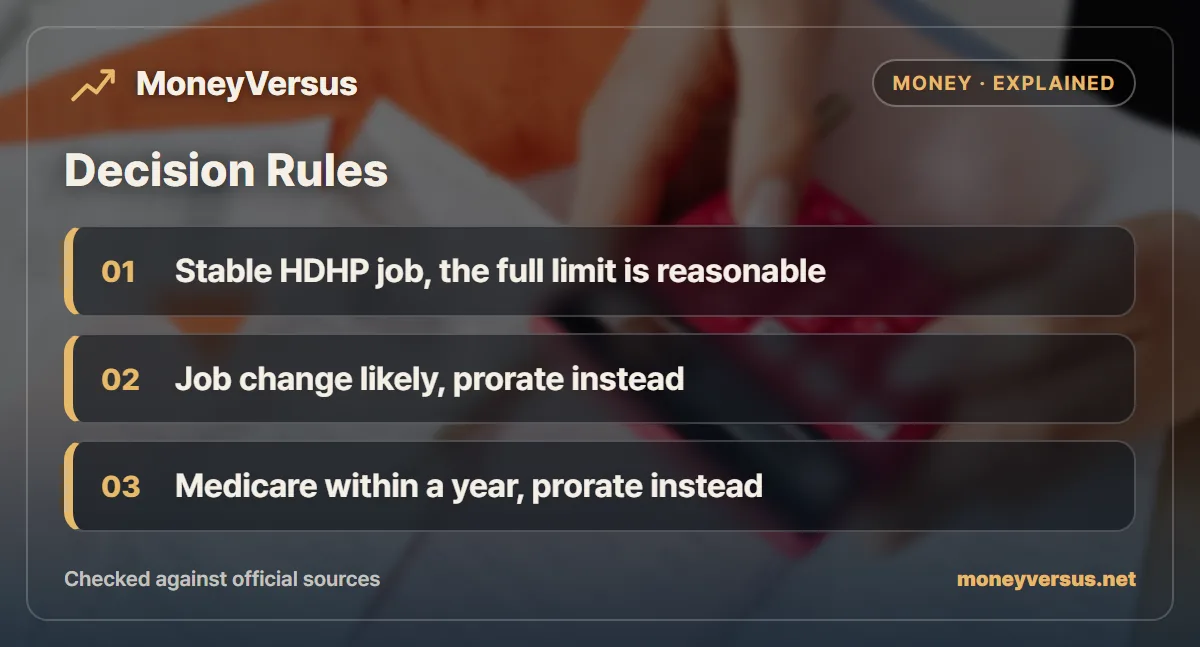
You expect to stay in the same HDHP job: The full limit is reasonable. The rule gives you a full year of tax-free room for a partial year of coverage.
A job change is likely within the year: Prorate. Contributing only for the months you were eligible avoids the income inclusion and the 10% charge.
You will turn 65 or plan to enroll in Medicare before 2028: Prorate. Enrolling in Medicare during the testing period is a failure.
You are unsure: You can contribute the prorated amount now and add the rest later. Publication 969 lets you contribute for a year up to the due date of your return, without extensions.
You are 55 or older: The $1,000 catch-up raises the limit under either method. Check the Form 8889 chart for how it applies in a partial year.
A Timeline From Late Start to Safe Harbor
The rule plays out over about 16 months. Mapping it out makes the risk easier to see.
- Fall 2026: HDHP coverage begins, and you become an eligible individual.
- December 1, 2026: You must be eligible on this date to use the last-month rule.
- By April 15, 2027: The deadline for making 2026 contributions, the regular return due date.
- All of 2027: Keep HDHP coverage and avoid Medicare enrollment.
- December 31, 2027: The testing period ends, and the 2026 contribution is no longer at risk.
Waiting until early 2027 to contribute the extra amount gives you a few months of extra information. You will know more about your job and coverage before committing the full limit.
How This Fits With Your Other Accounts
An HSA often competes with a 401(k) for the same dollars. Our guide to funding an HSA or a 401(k) after the match walks through that order.
If your employer offers both kinds of health account, our comparison of HSA vs FSA shows which one stays with you after you leave.
Workers near 65 have another timing question. Our guide to delaying Medicare Part B with job coverage explains how that choice interacts with work-based plans.
What These Figures Cover
The limits, HDHP rules and testing period come from IRS Publication 969 for 2025 returns, read on November 14, 2026. The 2026 brackets in the example come from IRS release IR-2025-103.
This is general information, not tax advice. State tax treatment of HSAs varies, so confirm your plan details and your return with a tax professional.
FAQ
Can you max out an HSA if you started an HDHP mid-year?
If you are an eligible individual on December 1, the last-month rule treats you as eligible for the whole year. For 2026 that lets you contribute up to $4,400 with self-only coverage or $8,750 with family coverage, even if you joined an HDHP late.
How long is the HSA testing period?
You must stay HSA-eligible from December 1 of the contribution year through December 31 of the following year. For 2026 contributions, that is December 1, 2026, through December 31, 2027.
What happens if you fail the HSA testing period?
The amount you contributed only because of the last-month rule is added to your income for the year you lose eligibility. That amount also owes a 10% additional tax, figured on Form 8889, Part III.
Are there exceptions to the testing period?
Publication 969 excludes failures caused by death or disability. Losing coverage for other reasons, such as a new job without an HDHP or enrolling in Medicare, counts as a failure.
Can you contribute to an HSA after enrolling in Medicare?
Your HSA contribution limit drops to zero starting with the first month you are enrolled in Medicare. Publication 969 says this also applies to retroactive Medicare coverage.
Sources
- IRS Publication 969 (2025), Health Savings Accounts and Other Tax-Favored Health Plans — checked 2026-11-14
- IRS: Tax inflation adjustments for tax year 2026 (IR-2025-103) — checked 2026-11-14
Some links may be affiliate links. We may earn a commission at no extra cost to you.
How this article was made: it was drafted with AI assistance from the official sources listed above, and its figures were checked against those pages on the dates shown. It is not based on personal hands-on testing.
Comments
Post a Comment