Missed an Estimated Tax Payment? Extra Withholding in December Can Erase the Penalty

Withholding Can Reach Back, a Late Check Cannot

With a paycheck, extra withholding before December 31 is the cheapest fix. IRS Publication 505 treats one-fourth of your withholding as paid on each due date. A late Form 1040-ES payment only counts from the day you send it.
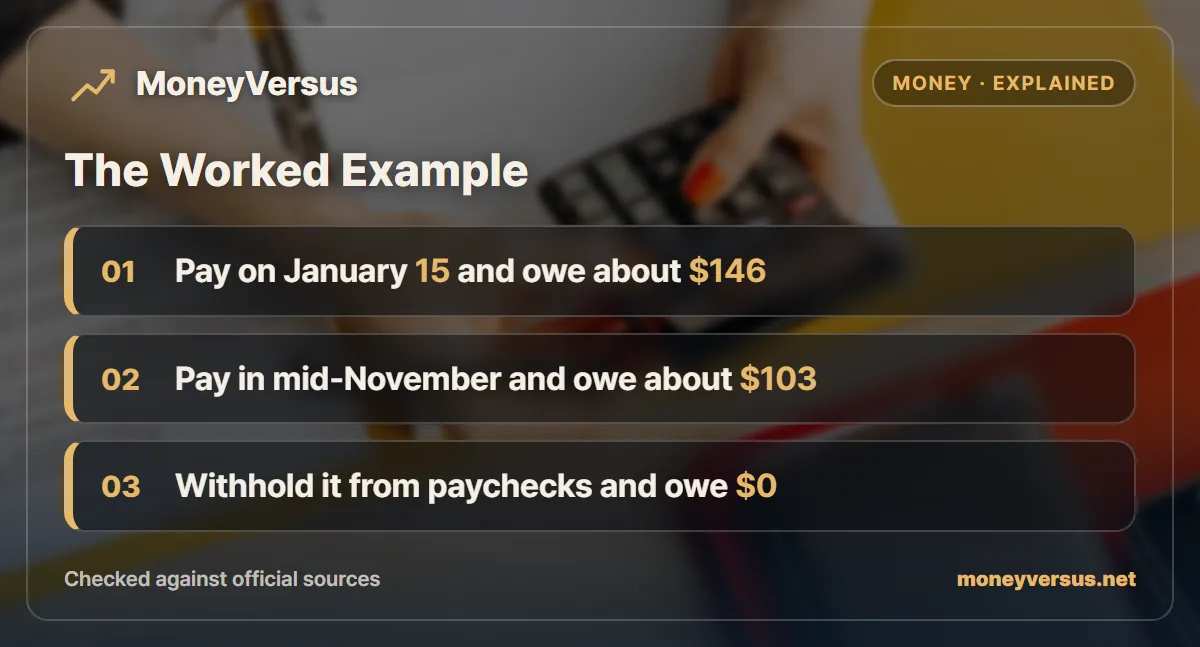
That difference decides the penalty. In the example below, the same $5,000 costs about $146 as a January check, about $103 as a November check and $0 as withholding.
The penalty is not a flat fine. It works like interest on each shortfall, and the IRS set that rate at 7% a year for the fourth quarter of 2026.
How the Penalty Is Counted
The penalty runs separately for each of the four payment periods. Publication 505 lists the 2026 due dates as April 15, June 15 and September 15, 2026, then January 15, 2027.
For each date, the IRS compares what you should have paid by then with what you actually paid. The IRS penalty page names three inputs. They are the amount underpaid, how long it stayed underpaid and the quarterly interest rate.
The IRS also figures the penalty for you. It sends a notice if you owe, and interest keeps building on the penalty until it is paid.
The Target You Have to Hit
You do not need to pay your exact final tax during the year. You need to reach a safe harbor, which is the smaller of two amounts.
| Situation | What you must pay in during 2026 | Where it comes from |
|---|---|---|
| Most taxpayers | Smaller of 90% of 2026 tax or 100% of 2025 tax | Publication 505, general rule |
| 2025 AGI over $150,000 | Smaller of 90% of 2026 tax or 110% of 2025 tax | Publication 505, higher income rule |
| Married filing separately, 2025 AGI over $75,000 | Same 110% test | Publication 505, higher income rule |
| Two-thirds of income from farming or fishing | 66 2/3% instead of 90%, one due date of January 15, 2027 | Publication 505, farmers and fishermen |
| Balance due under $1,000 after withholding and credits | No penalty | IRS Topic 306 |
| Return filed and paid by January 31, 2027 | January 15 installment not needed | Publication 505, January payment |
Each installment is normally one quarter of that target. If your safe harbor is $14,000, each due date expects $3,500 on a running basis.
Your 2025 return has to cover all 12 months for the prior-year test to work. People who started filing mid-year should use the 90% test instead.
Why Withholding Is Treated Differently
Publication 505 says one-fourth of your estimated withholding is considered withheld on each due date. A dollar withheld from a December paycheck is spread across April, June, September and January.
You can choose to use the actual dates instead. That only helps when most of your withholding came early in the year, and it requires Form 2210.
Estimated payments get no such spreading. A $5,000 payment on January 15 sits in the January column only, so April through September stay short for every day before it.
Three Ways to Close a 5,000 Dollar Gap
This is an illustration with assumed numbers. Dana is a salaried designer with a freelance side business, and her 2025 AGI was $95,000.
Her 2025 tax was $14,000, and her 2026 tax looks like about $16,000. The smaller safe harbor is 100% of 2025, so she needs $14,000 in by January 15, 2027.
Her employer will withhold $9,000 this year. She meant to send estimated payments for the side income but missed all three so far.
| Running total by due date | Required | Withholding at $9,000 | Short |
|---|---|---|---|
| April 15, 2026 | $3,500 | $2,250 | $1,250 |
| June 15, 2026 | $7,000 | $4,500 | $2,500 |
| September 15, 2026 | $10,500 | $6,750 | $3,750 |
| January 15, 2027 | $14,000 | $9,000 | $5,000 |
She has three ways to send the missing $5,000. The penalty estimates below use 7% for the whole span, which was the fourth-quarter rate.
| Option | How the $5,000 is paid | Days the gap stays open | Estimated penalty |
|---|---|---|---|
| A | Form 1040-ES on January 15, 2027 | 61, 92 and 122 days at rising balances | About $146 |
| B | Form 1040-ES around November 15, 2026 | Same, but the last gap closes 61 days after September 15 | About $103 |
| C | Extra W-4 withholding from November and December paychecks | None, since $14,000 of withholding counts as $3,500 per date | $0 |
Option A multiplies $1,250 by 61 days, $2,500 by 92 days and $3,750 by 122 days. That totals 763,750 dollar-days, and 7% divided by 365 turns it into about $146.
Option B cuts the last stretch to 61 days and lands near $103. Option C leaves nothing short on any date, because the extra $5,000 of withholding is spread back across the year.
The real figure on her notice may differ slightly. The rate is reset each quarter, and Form 2210 applies the rate that was in force for each stretch.
How to Raise Withholding Before Year End
Give your employer a new Form W-4 and enter the extra amount per paycheck in Step 4(c). Divide the gap by the number of paychecks left after the change takes effect.
Dana has four paychecks left, so she asks for $1,250 extra per check. If payroll needs a week to process the form, she should spread it over three checks instead.
The IRS penalty page also points to its Tax Withholding Estimator. It is worth a run with your latest pay stub before you pick a number.
Check your last pay stub of the year. The year-to-date federal withholding line should show the total you planned.
When Withholding Is Not an Option
Some people have no paycheck to adjust. A full-time freelancer with only 1099 income has to use Form 1040-ES, and sooner is cheaper.
Every week of delay adds interest on the largest gap. Paying the missing amount now stops the penalty from growing, even though April through September still count as late.
If income came in unevenly, look at the annualized income installment method. It figures tax period by period, so a large December invoice does not count as if it had arrived in April.
That method needs Schedule AI on Form 2210, filed with your return. Our guide on how much of freelance income to set aside for taxes covers keeping cash ready for each due date.
The January 31 Shortcut and Its Limit
Publication 505 offers one more route for the last installment. If you file your 2026 return by January 31, 2027 and pay all remaining tax, you do not need the January 15 payment.
That helps people whose problem is only the fourth quarter. It does not fix shortfalls in April, June or September, which are measured on their own dates.
Filing that early also needs every W-2 and 1099 in hand. Many forms do not arrive until late January, so treat this as a backup plan.
Mistakes That Keep the Penalty Alive
Most lingering penalties come from a few predictable errors. Each one is easy to avoid once you know the rules above.
Paying the full year with the January check. It covers January only. The earlier periods stay short for every day before the money arrived.
Using the wrong prior-year figure. The test uses the tax shown on your 2025 return, not the amount you owed in April. A big refund last year does not lower the target.
Missing the 110% rule. A 2025 AGI over $150,000 raises the prior-year target by a tenth. On a $30,000 tax bill, that is $3,000 more to pay in.
Expecting a waiver for a busy year. The IRS says this penalty generally cannot be waived for reasonable cause. Waivers cover casualties, disasters and some cases of retirement after 62 or disability.
Which Catch-Up Method Fits Your Situation

Start by writing down your safe harbor and your withholding so far. The gap between them tells you how much has to move before January 15, 2027.
You have a paycheck and time left this year: Raise withholding on a new W-4. It is the only method that can bring the penalty for earlier quarters to zero.
You have a paycheck but payroll has closed for the year: Send a Form 1040-ES payment now rather than in January. Every week earlier trims the interest.
You have no paycheck at all: Pay the full gap through IRS Direct Pay or Form 1040-ES as soon as you can. Check Schedule AI if most of the income arrived late.
Your gap is under $1,000 at filing: You may owe no penalty at all. Pay the balance by April 15, 2027 and adjust next year.
You are married and file jointly: Either spouse can raise withholding, since the return counts the household total. The spouse with more paychecks left usually spreads it more easily.
Setting Up 2027 So This Does Not Repeat
A one-time fix in December does not solve next year. Take your 2026 safe harbor and split it between withholding and four estimated payments in advance.
If your side income is steady, raising withholding all year may be simpler than four reminders. Our look at whether a big tax refund is a bad thing covers how far to push that.
If you end up owing a large balance in April anyway, compare your payment options first. Our guide on paying a tax bill by credit card or IRS payment plan sets out the costs.
What These Figures Cover
The rules come from the 2026 edition of IRS Publication 505 and IRS Topic 306, read on November 11, 2026. The 7% rate is from IRS release IR-2026-98 for October through December 2026.
The example uses assumed income and tax figures and a single rate for the whole year. This is general information, not personal tax advice, so confirm your own numbers with tax software or a professional.
FAQ
What happens if I miss an estimated tax payment?
You may owe the underpayment penalty, which works like interest on the amount short for each payment period. The IRS sets the rate each quarter, and it was 7% a year for the fourth quarter of 2026.
Can extra withholding make up for missed estimated payments?
Yes, for people who also have a paycheck. IRS Publication 505 treats one-fourth of your withholding as paid on each due date, so extra withholding late in the year counts toward the earlier quarters too.
Does a late estimated payment count for the earlier quarters?
No. A payment made with Form 1040-ES is credited on the date you make it. It stops the penalty from growing, but the earlier periods stay underpaid for the days before you paid.
How much do I have to pay to avoid the penalty?
Pay at least the smaller of 90% of your 2026 tax or 100% of your 2025 tax through withholding and estimated payments. If your 2025 AGI was over $150,000, or $75,000 filing separately, use 110% of your 2025 tax.
Can I skip the January estimated tax payment?
Only if you file your 2026 return by January 31, 2027 and pay the rest of the tax owed. That replaces the January 15 installment, but it does not cover the April, June or September periods.
Sources
- IRS Publication 505 (2026): Tax Withholding and Estimated Tax — checked 2026-11-11
- IRS Topic 306: Penalty for underpayment of estimated tax — checked 2026-11-11
- IRS: Underpayment of estimated tax by individuals penalty — checked 2026-11-11
- IRS: Interest rates remain the same for the fourth quarter of 2026 (IR-2026-98) — checked 2026-11-11
- IRS: Estimated tax FAQs for individuals — checked 2026-11-11
Some links may be affiliate links. We may earn a commission at no extra cost to you.
How this article was made: it was drafted with AI assistance from the official sources listed above, and its figures were checked against those pages on the dates shown. It is not based on personal hands-on testing.
Comments
Post a Comment