How Credit Scores Work: FICO and VantageScore Explained (2026)

The Number Behind Every Loan Decision
The short version: payment history and utilization drive most of the score, so for most people paying on time and keeping balances low moves the number more than any trick.
Few three-digit numbers shape your finances as quietly as a credit score. It influences whether a loan gets approved, and often the interest rate you pay on it. Yet most people never learn what actually moves the number.
This guide explains how credit scores are built and what changes them. It skips the hype and focuses on the mechanics behind the number. The goal is a clear, neutral picture you can put to use.
Understanding the score helps you make calmer decisions and spot costly errors. It also takes the mystery out of small monthly changes. Let’s start with the short version, then dig into the factors.
Where the Number Comes From

A credit score is calculated from the information in your credit reports. Scoring models read that data and turn it into a number, usually between 300 and 850. Payment history and how much you owe carry the most weight.
The two most common models are FICO and VantageScore. Both use similar inputs but weigh them slightly differently. A lender may use either one, so your number can vary by source.
The biggest levers are simple. Pay on time, keep balances low, and avoid opening many new accounts at once. For deeper habits, see our guide on how to build credit.
The Three Categories That Do the Work
When you review your credit, focus on the factors that actually drive the score. Not every detail matters equally. A few categories do most of the work.
Payment History
Payment history is usually the single largest factor. It tracks whether you pay bills on time across loans and credit cards. Even one late payment can have a visible effect.
Amounts Owed
This factor looks at how much you owe relative to your limits. The ratio of balances to limits is called credit utilization. Lower utilization generally signals lower risk. Our guide on how much of your credit limit you should use puts real numbers on that ratio.
Length and Mix
The age of your accounts and the variety of credit types both play a role. Older accounts and a healthy mix can help. New credit and recent inquiries can pull the number down slightly.
Four Scoring Systems You Will Meet
There is no single “score” everyone uses, but a few models dominate the market. Knowing which is which helps you read your numbers correctly. Below are the main scoring systems and where they appear.
FICO Score
FICO is the most widely used scoring model among lenders. Many mortgage, auto, and card decisions rely on a FICO version. It emphasizes payment history and amounts owed heavily.
VantageScore
VantageScore was created jointly by the three major credit bureaus. Many free credit monitoring tools display a VantageScore. It uses a similar 300 to 850 range and similar factors.
Bureau-Specific Scores
Equifax, Experian, and TransUnion each hold their own data. Your score can differ slightly across bureaus because their files are not identical. Lenders sometimes pull from one bureau or all three.
Industry-Specific Scores
Some scores are tuned for a specific product, like auto loans or credit cards. These versions adjust the math for that lending category. The core idea stays the same even when the numbers shift.
FICO Against VantageScore
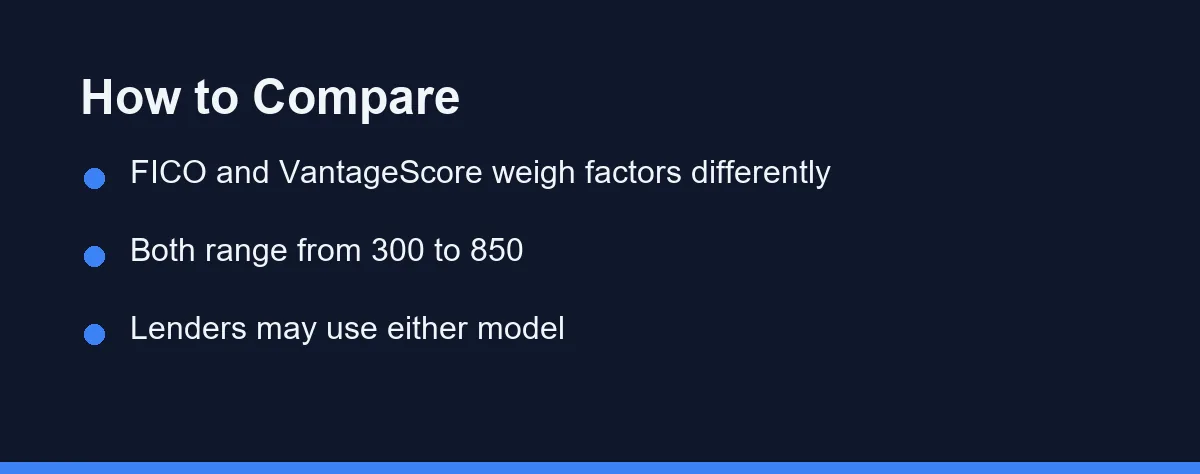
The table below compares the two most common scoring models at a high level. Use it to understand differences, not to chase one number. Both aim to predict repayment risk.
| Feature | FICO Score | VantageScore | Why It Matters |
|---|---|---|---|
| Score range | 300 to 850 | 300 to 850 | Same scale makes numbers feel comparable |
| Top factor | Payment history | Payment history | On-time payments dominate both models |
| New-file scoring | Needs longer history | Can score thinner files | Affects people new to credit |
| Common use | Many lender decisions | Many free monitoring tools | Determines where you see each score |
| Inquiry handling | Groups rate shopping | Groups rate shopping | Limits damage from comparison shopping |
| Score tiers | Named bands, poor to exceptional | Similar tiered ranges | Both sort scores into quality bands |
| Free access | Some free via banks and cards | Widely free on monitoring sites | You can check either without paying |
The key takeaway is that both models reward the same behavior. On-time payments and low balances help under either system. The exact number is less important than the trend.
What Moves Your Score
Not every factor carries equal weight, so it helps to see them side by side. The table below shows the main drivers and the action that helps each one. Focus your energy on the factors near the top.
| Factor | Impact on Score | What Helps |
|---|---|---|
| Payment history | Largest | Pay every bill on time, every time |
| Amounts owed (utilization) | High | Keep balances well below your limits |
| Length of history | Moderate | Keep older accounts open |
| Credit mix | Smaller | Blend revolving and installment over time |
| New credit and inquiries | Smaller | Space out new applications |
The top two factors do most of the work. If you only change two habits, make them on-time payments and lower utilization. The rest support your score but move it more slowly.
Mistakes on the payment side linger. The CFPB says a credit reporting company can generally report most negative information for 7 years, and bankruptcies can stay for up to 10 years.
Which Move Fits Your Situation
The best next step depends on where you are starting from. Below are direct starting points for common situations. Pick the one that matches your profile today.
If you are brand new to credit: Focus on opening one starter account that reports to the bureaus. On-time payments build the payment history that both models weigh most. Our guide on how to build credit walks through the first steps.
If your card balances are high: Prioritize lowering utilization before anything else. Paying balances down before the statement closes can move the number within a cycle or two. This is often the fastest lever you control.
If you have a thin credit file: A VantageScore may appear before a FICO score does, since it can score thinner files. Adding a small, well-managed account helps thicken the file. Patience matters, because history needs time to grow.
If you recently missed a payment: Get current immediately and stay current going forward. A single late mark fades in impact as months of on-time payments pile up. Consistency slowly repairs the largest factor.
If you are about to apply for a big loan: Avoid opening new accounts in the months beforehand. Each hard inquiry can cause a small, temporary dip at the worst time. Keep balances low so your file looks its strongest.
If you want to track these numbers over time, budgeting tools can help. Pairing credit monitoring with a plan from the best budgeting apps keeps everything in one view. Consistency matters more than any single check.
Four Habits You Actually Control

You do not really “choose” a credit score, but you can choose how you manage it. Your daily habits shape the number more than any tool. Focus on the levers you control.
Prioritize On-Time Payments
Set up autopay or reminders so no due date slips. A single missed payment can linger on your report for years. Reliability is the foundation of a strong score.
Manage Utilization
Try to keep balances well below your credit limits. Paying down cards before the statement closes can lower reported utilization. This is one of the faster ways to see movement.
Be Strategic With New Credit
Open new accounts only when you have a clear reason. Each application can trigger a hard inquiry and a small dip. Spacing out applications protects your score.
Watch Your Reports
Review your credit reports regularly for mistakes. Errors in payment history or balances can drag your score down unfairly. Disputing them is free and worth the effort.
Free Checks Versus Paid Monitoring
Checking your credit score is often free, and so are your reports. Federal law gives you a free report from each nationwide bureau once every 12 months, and the FTC says all three now allow a free weekly check at AnnualCreditReport.com. Many banks, card issuers, and apps now show a score for free. Always confirm current details on official sites before relying on any offer.
Paid credit monitoring services also exist and bundle extra features. These can include alerts, identity protection, or scores from all three bureaus. Prices and features vary widely, so compare options on each provider’s official page.
Be cautious of services that promise instant or guaranteed score boosts. Legitimate improvement comes from changed behavior, not paid shortcuts. If a fee feels unclear, verify it directly with the company.
For broader money management, scoring fits into a larger toolkit. Comparing options like the best personal finance software can help you track credit alongside spending. The right setup depends on your own goals and budget.
Watch the Trend, Not the Digit
Credit scores look mysterious until you know the inputs, then they become predictable. They reward steady, on-time behavior far more than any clever trick. Pay on time, keep balances low, and review your reports for errors.
Both FICO and VantageScore measure the same core habits, so the exact number matters less than the direction. It will differ across models and bureaus, and that is normal. Watch the long-term trend instead of obsessing over small swings.
With patience and consistency, most people can strengthen their score over time. Treat it as a snapshot of habits, not a verdict on your worth.
That is also why two apps can show you two different numbers on the same day. Why your credit score is different on every app explains which model each one is reporting and when the gap is worth a second look.
This article is for general education only and is not financial advice; consult a qualified professional for your situation.
FAQ
What is a good credit score in 2026?
Most lenders treat scores in the mid-700s and above as very good to excellent, while scores below the low 600s are often seen as higher risk. Exact cutoffs differ by lender and product, so a score that qualifies for one loan may not for another.
How long does it take to improve a credit score?
Small improvements can appear within a month or two after positive changes like lowering balances. Bigger gains usually take six months to a year of consistent on-time payments and patience.
Does checking my own credit score lower it?
No, checking your own score is a soft inquiry and does not affect it. Only hard inquiries from new credit applications can cause a small, temporary dip.
Why is my credit score different on each app?
Each app may show a score from a different model, such as FICO or VantageScore, and pull from a different bureau. Since the three bureaus hold slightly different data, the numbers rarely match exactly. Focus on the trend across time rather than one specific figure.
What is the fastest way to raise my credit score?
Lowering your card balances before the statement closes can move utilization quickly, sometimes within a cycle or two. Making every payment on time protects the largest factor. There is no legitimate overnight fix, so treat any such promise with caution.
Sources
- CFPB: What is a credit score? — checked 2026-09-27
- CFPB: How long does negative information remain on my credit report? — checked 2026-09-27
- FTC: Free Credit Reports — checked 2026-09-27
Some links may be affiliate links. We may earn a commission at no extra cost to you.
How this article was made: it was drafted with AI assistance from the official sources listed above, and its figures were checked against those pages on the dates shown. It is not based on personal hands-on testing.
Comments
Post a Comment