How to Build Credit From Scratch: A 2026 Guide

Nobody Lends To A Blank File
For most people the answer is one account that reports to the major bureaus, paid on time for months; a secured card or credit-builder loan usually starts it.
A credit file that does not exist is not the same as a bad one. It is simply empty, and an empty file gives a lender nothing to read. That blankness, not any past mistake, is what stops most first-timers.
The fix is narrower than it sounds. You do not need several accounts or a clever strategy. You need one account that reports your payments to the major bureaus, and then a stretch of unremarkable months.
This guide covers what reporting actually means, which starter tools create it, and how the main options compare on cost. It sticks to general education rather than personalized advice.
A credit score is simply a number that summarizes how you have handled borrowed money. It is built from the data in your credit reports. To learn the mechanics in depth, see our explainer on how credit scores work.
The question that follows almost immediately is timing. You will want a realistic schedule for when a first number appears and when it starts mattering to a lender. Our guide on how long it takes to build credit from scratch lays out the milestones month by month.
One Reporting Account, Then Patience

To build credit from scratch, you need at least one account that reports to the major credit bureaus. The most common starting points are secured credit cards, credit-builder loans, and authorized-user status.
After that, the formula is simple but slow. Pay every bill on time, keep balances low, and avoid opening several accounts at once.
Most people see a first score within about six months of activity. A strong profile takes longer, usually a year or more of clean payments.
What The Lender Reports, And When
The whole exercise depends on data reaching the bureaus. A product that never reports cannot help you, no matter how convenient or cheap it is.
Reporting to All Three Bureaus
Equifax, Experian, and TransUnion each keep separate files. A product that reports to all three builds the broadest history. Always confirm reporting before you sign up, since some prepaid cards report to none. To check that it shows up, federal law gives you a free report from each bureau once every 12 months, and the FTC says all three now offer free weekly checks at AnnualCreditReport.com.
Reporting Timing and Gaps
Most accounts report on a monthly cycle, but the exact date varies by issuer. A card that reports your balance before you pay it can make your usage look higher than it is. Paying a few days early smooths that out.
Low or Transparent Fees
Some starter products charge annual fees, monthly fees, or setup costs. Lower fees mean more of your money goes toward building, not maintenance. Read the fee schedule carefully before committing.
A Deposit or Payment You Can Handle
Secured cards require a refundable deposit, while builder loans require monthly payments. Choose an amount you can comfortably cover every month. Missing payments on a credit-building product defeats the entire purpose. The CFPB says a credit reporting company can generally report most negative information for 7 years.
Six Ways To Get A First Account
There is no single best path, only the option that fits your cash flow and access. Below are the tools people most often use to establish a first credit profile.
Secured Credit Cards
A secured card requires a refundable cash deposit that usually sets your credit limit. You use it like a normal card and pay the balance each month. After a period of good behavior, many issuers refund the deposit or upgrade you.
Credit-Builder Loans
With a credit-builder loan, the lender holds the loan amount in a locked account. You make fixed monthly payments, and those payments are reported as positive history. At the end, you receive the saved funds, often minus interest or fees.
Authorized User Status
A trusted family member can add you as an authorized user on their card. Their positive history can appear on your report, helping you start faster. This only works if the primary account stays in good standing.
Reported Rent and Bills
Some services report your rent, utility, or phone payments to the bureaus. This turns expenses you already pay into credit-building activity. Coverage varies, so confirm which bureaus receive the data.
Student and Retail Cards
Student cards are aimed at applicants with thin files and some income. Retail store cards are often easier to obtain but carry narrow usefulness. Both are revolving accounts, so the same balance and payment rules apply.
Two situations deserve their own walkthrough. If none of these six routes involve a card at all, building credit without a credit card covers the loan and rent-reporting paths in detail.
If you are starting out in your first decade of adult finances, building credit in your 20s sequences the same tools around rent, student loans, and a first salary.
Six Starter Tools, Cost And Coverage
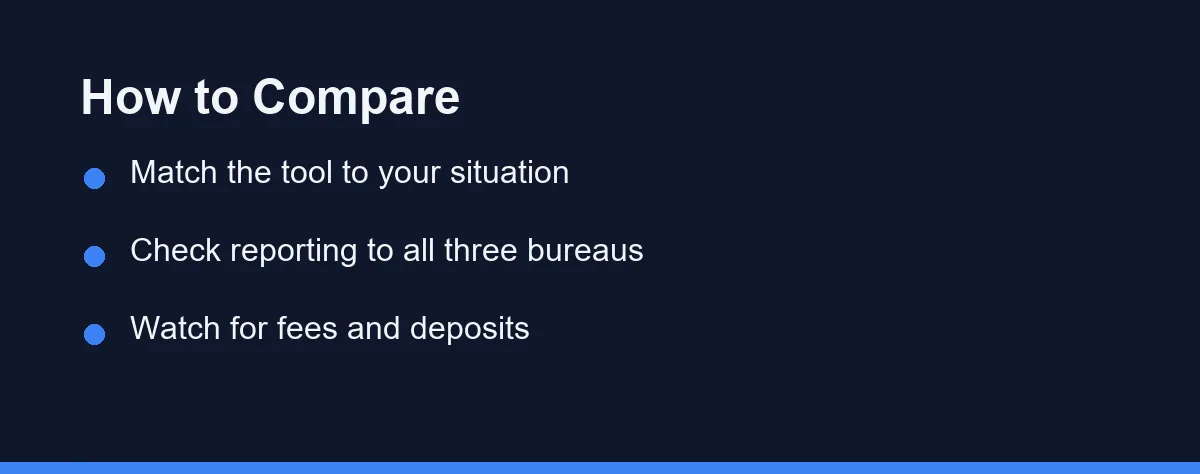
The table below compares common starting tools at a glance. Specific costs change often, so treat these as general patterns rather than guarantees. Always confirm current terms on the provider’s official site.
| Option | Upfront Cost | Builds History Via | Best For |
|---|---|---|---|
| Secured credit card | Refundable deposit | Revolving payments | Everyday spenders |
| Credit-builder loan | Small fees possible | Installment payments | Disciplined savers |
| Authorized user | Usually none | Shared account record | Those with helpful family |
| Reported rent/bills | Subscription possible | Recurring bill payments | Renters and tenants |
| Student credit card | Possible annual fee | Revolving payments | Students with some income |
| Retail store card | Usually none | Revolving payments | Regular store shoppers |
A revolving account and an installment account affect your file in different ways. Having both over time can show a healthy credit mix. To track these payments easily, pair any tool with one of the best budgeting apps.
The strongest starter account is the one you can manage without a missed payment. The framework below points common situations toward a tool and the detail to verify first. These pairings are approximate and reflect typical patterns at the time of writing.
| Your Situation | Tool to Start With | What to Confirm First |
|---|---|---|
| Have cash for a deposit | Secured credit card | Deposit amount and bureau reporting |
| Prefer fixed monthly payments | Credit-builder loan | Fees and reporting frequency |
| Have a willing family member | Authorized user | Their on-time history and low balance |
| Rent and pay utilities on time | Rent or bill reporting | Which bureaus receive the data |
The table is a starting map, not a ranking. Any of these can work well when it reports reliably and fits your budget. The wrong tool is the one that tempts a late payment.
What A Starter Account Costs

Costs vary widely by provider, product type, and your profile. Some secured cards charge no annual fee, while others do. Credit-builder loans may include modest interest or administrative fees, so the exact numbers depend on the lender.
Because rates and fees change frequently, this guide does not quote specific figures. Always confirm current pricing, deposit requirements, and reporting practices on the official site before applying. Comparing two or three offers side by side is a smart habit.
Watch for products that promise instant results for a high fee. Legitimate credit building takes time and rarely requires premium upfront charges. If something sounds too fast or too good, read the fine print carefully.
Cost only means something in context. A small fee on a tool that reports reliably may be worth paying. A free tool that reports to no bureau offers little value at any price.
Then automate the rest. Set up autopay to avoid late payments, the single most damaging credit mistake, and keep usage low relative to your limits. A good expense routine helps, so consider the best expense tracker apps to stay aware of balances.
Many people pair a starter account with broader money tools to stay organized. Tracking due dates reduces the risk of an avoidable late payment. For a wider toolkit, browse the best personal finance software.
Which Tool Fits Your Situation
No single tool is best for everyone, so match it to your resources and habits. The picks below map common situations to the option that usually fits.
- If you can set aside a deposit: a secured card offers everyday flexibility while it reports.
- If you want built-in discipline: a credit-builder loan enforces fixed, reported payments.
- If a trusted relative will help: authorized-user status can jump-start your history.
- If you rent and pay bills on time: rent and bill reporting turns existing payments into credit.
- If you are unsure where to start: one no-fee account that reports to all three bureaus beats several you cannot manage.
Whatever you pick, the mechanics that follow matter more than the product. On-time payments and low balances drive almost all of your early progress.
The Habit Outlives The Product
The starter account is scaffolding. Within a year or two you will likely have moved on from it, and what remains is the payment record it created.
So choose for reliability rather than features. Confirm it reports, confirm you can afford it every month, and automate the payment before the first bill arrives.
Then let it get boring. Credit rewards repetition more than effort, and the file that looked blank six months ago starts answering for you.
Protecting a file you have just built is a separate decision. Credit freeze vs fraud alert vs credit monitoring compares what each option actually blocks and what it costs you in convenience.
This article is for general education only and is not financial advice; consult a qualified professional for your situation.
FAQ
How long does it take to build credit from scratch?
Most scoring models need about six months of activity to generate your first score. Building a strong profile usually takes longer, often a year or more of on-time payments.
Can I build credit without a credit card?
Yes, options like credit-builder loans, reported rent payments, and being an authorized user can all add positive history. A mix of account types can help over time.
Does checking my own credit hurt my score?
No, checking your own report is a soft inquiry and does not affect your score. Only hard inquiries from new credit applications can cause a small, temporary dip.
Does closing my first credit account hurt my score?
Closing an account can shorten your average account age and reduce your available credit. Both factors may lower your score slightly. Many people keep a no-fee starter card open to preserve history.
How many credit accounts do I need to build a good score?
You do not need many accounts, since one well-managed account can start a score. Over time, a mix of revolving and installment accounts can help your profile. Focus on on-time payments rather than opening lots of accounts at once.
Sources
- CFPB: How long does negative information remain on my credit report? — checked 2026-09-27
- FTC: Free Credit Reports — checked 2026-09-27
Some links may be affiliate links. We may earn a commission at no extra cost to you.
How this article was made: it was drafted with AI assistance from the official sources listed above, and its figures were checked against those pages on the dates shown. It is not based on personal hands-on testing.
Comments
Post a Comment