Roth IRA vs 401(k): Which Should You Fund First in 2026?
Which Account Gets the Next Dollar
For most savers a sensible order is match first, Roth IRA second, then more 401(k), because the employer match is compensation no other account can replace.
Saving for retirement often starts with a single question. Should new money go into a 401(k) or a Roth IRA first? Both are powerful, but they work in different ways.
The confusion is understandable. One account lowers your taxes today, while the other rewards you with tax-free income later. They can even be used together.
This guide compares the two for everyday savers building a plan. We will look at taxes, employer match, limits, and access. The aim is a clear order of operations.
By the end, you will understand a sensible funding sequence. Your tax situation and your employer’s match will shape it. This article is for general education only and is not financial or tax advice.
Match, Then Roth, Then Back

If your employer offers a 401(k) match, fund the 401(k) first up to the full match. That match is essentially an immediate return you do not want to skip. Missing it leaves part of your pay unclaimed.
After you have captured the full match, a Roth IRA is often the next stop. It offers tax-free qualified withdrawals and more flexible investment choices. For many savers, that flexibility is worth prioritizing next.
Once the Roth IRA is funded for the year, extra savings can go back to the 401(k). This match-then-Roth-then-401(k) order suits a lot of situations. Your own tax picture may adjust it.
Match, Tax Timing, Limits, Access
Start with the employer match, because it is the clearest win. A full match is a guaranteed boost that no other account offers. Always contribute at least enough to earn all of it.
Next, weigh when you want the tax break. A traditional 401(k) usually cuts taxable income now, while a Roth IRA delivers tax-free income later. Younger or lower-earning savers often favor the Roth side.
Consider the contribution limits for each account. For 2026 the IRS sets the 401(k) elective deferral limit at $24,500 against $7,500 for an IRA. Limits change yearly, so confirm current numbers on IRS.gov.
Finally, think about access and rules before you commit. Roth IRA contributions can generally be withdrawn without penalty, unlike most 401(k) money. For a plan to fund these accounts, see our guide on how to make a budget.
Two Accounts and One Sequence
Retirement accounts fall into a few clear shapes. Each plays a distinct role in a plan. Use them together rather than picking only one.
Traditional 401(k)
A traditional 401(k) is an employer-sponsored plan funded before tax. Contributions lower your taxable income now, and many employers add a match. Withdrawals in retirement are taxed as income.
The strengths are the match and the high contribution limit. Savers age 50 and over can add $8,000 more for 2026, and $11,250 instead if they are aged 60 to 63. The trade-offs are limited investment menus and taxes later. It shines as the first place to capture free match money.
Roth IRA
A Roth IRA is an individual account funded with after-tax dollars. Qualified withdrawals in retirement are generally tax-free, which is its headline benefit. You also choose from a wide range of investments.
The catches are income eligibility limits and a smaller contribution cap. But the flexibility is real, since contributions can usually be withdrawn penalty-free. It fits well as the second priority after the match.
The 2026 numbers make both catches concrete. Direct Roth contributions phase out between $153,000 and $168,000 of modified AGI for single filers, and between $242,000 and $252,000 for married couples filing jointly. The IRA catch-up adds $1,100 from age 50, lifting the cap to $8,600.
Using Them Together
Most savers do not have to choose only one account. A common flow is match first, Roth IRA second, then more 401(k). This blends free money, tax-free growth, and higher limits.
Let your tax rate and goals guide the mix. If you expect higher taxes later, the Roth side gains appeal. For where to hold and invest IRA money, see our best investment apps for beginners guide.
Six Rules That Set Them Apart
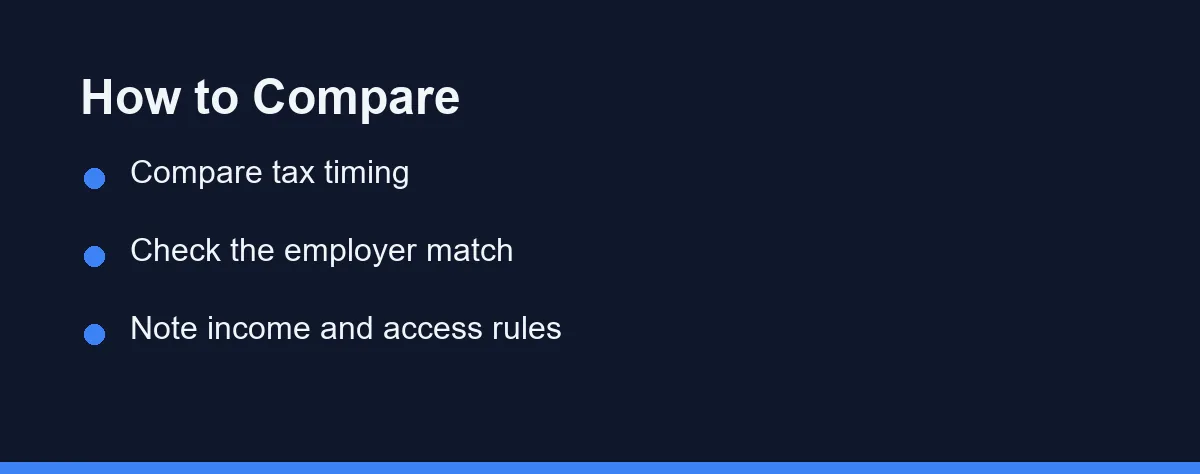
The table below summarizes how the two accounts compare. Use it as a quick reference, not a strict verdict. Always confirm current rules and limits on IRS.gov.
| Feature | Traditional 401(k) | Roth IRA |
|---|---|---|
| Tax on contributions | Usually pre-tax | After-tax |
| Tax on withdrawals | Taxed as income | Generally tax-free |
| Employer match | Often available | Not applicable |
| 2026 contribution limit | $24,500 | $7,500 |
| Income limits to contribute | None | Phases out above $153,000 single |
| Early access to contributions | Restricted | Generally penalty-free |
The two accounts solve different problems. The 401(k) wins on match and raw contribution room. The Roth IRA wins on tax-free growth and flexible access.
That is why many plans use both in sequence. Capture the match, then chase tax-free growth. Return to the 401(k) once the Roth is full.
Ordering Your Own Contributions

Begin with the employer match, if you have one. Contribute enough to your 401(k) to earn every matching dollar. This is the highest-priority step for most people.
Next, decide where you want the tax advantage. If you prefer tax-free retirement income, lean toward the Roth IRA next. If you prefer a bigger deduction now, weight more toward the traditional 401(k).
Then check your eligibility and limits. Roth IRAs phase out at higher incomes, and all limits change yearly. Confirm the current figures on the official IRS site before contributing.
Finally, automate whatever order you choose. Steady, automatic contributions matter more than perfect account selection. Consistency is what builds the balance over time.
Which Account Should You Fund First
The ordering changes with your employer’s plan and your tax picture, so the common advice does not fit everyone. Below are starting points for typical situations. This is general education rather than personal advice, and a tax professional can check it against your own numbers.
If your employer offers any match: Contribute at least enough to capture the full match before anything else. The match is compensation attached to your own contribution, so leaving it behind is a straight loss no other account can make up. Read your plan documents for the exact formula and any vesting schedule.
If there is no match at all: A Roth IRA opened at a low-cost provider like Fidelity or Vanguard is often the more attractive first stop. You get a wide investment menu and no employer plan fees layered on top. The 401(k) still earns its place once the IRA is funded for the year.
If your plan’s fund menu is expensive or thin: Take the match, then move to a Roth IRA before returning to the 401(k). High plan expenses quietly compound against you over decades in the same way returns compound for you. Compare the expense ratios in your plan against comparable index funds outside it.
If you expect to be in a higher tax bracket later: Roth contributions look more attractive, because you pay tax now at the lower rate and qualified withdrawals come out tax-free. If you expect a lower bracket in retirement, pre-tax 401(k) contributions may serve you better. Nobody knows future tax law, which is one argument for holding some of each.
If your income is high: Direct Roth IRA contributions close off above $168,000 of modified AGI for single filers in 2026, and above $252,000 for joint filers. Those thresholds move each year, so check current IRS guidance before assuming you can contribute directly. Ask your employer whether the plan offers a Roth 401(k) option, which has no income limit of that kind.
Expense Ratios and Plan Fees
Neither account has a purchase price, but costs still exist inside them. Investment fees, fund expense ratios, and any plan administration fees quietly affect returns. Always review the fees before assuming a plan is cheap.
A 401(k) menu is set by your employer, so options and costs vary. Some plans offer low-cost index funds, while others carry pricier choices. Compare the expense ratios you can pick from.
A Roth IRA at a major brokerage often gives you low-cost fund access. That control can reduce fees compared with a limited 401(k) menu. Confirm any account or fund fees on the official provider site.
Focus on the net return after fees, not the headline. A small difference in expense ratios compounds over decades. Keeping costs low is one of the few things you fully control.
Where Retirement Savers Leave Money Behind
Savers make a few avoidable mistakes with these accounts. Sidestepping them protects both your match and your growth.
Do not skip the employer match. Contributing too little to earn the full match leaves guaranteed money behind. Fund at least to the match before anything else.
Do not assume one account is always better. The right answer depends on your tax rate now versus later. Using both often beats forcing a single choice.
Do not ignore the income limits on a Roth IRA. Higher earners may be reduced or phased out entirely. Confirm your eligibility on IRS.gov before contributing.
Do not treat retirement contributions as optional in busy months. Automating them keeps the plan on track when life gets hectic. Consistency compounds more than timing.
Do not forget that limits and rules change each year. Contribution caps and income thresholds are adjusted regularly. Check the current figures before you set your annual plan.
Automate the Order and Revisit Yearly
The Roth IRA and 401(k) both help you build retirement savings, but in different ways. The 401(k) offers an employer match and high limits, while the Roth IRA offers tax-free growth and flexibility. Neither is universally better.
For most savers, a sensible order is match first, Roth IRA second, then more 401(k). That sequence grabs free money, then tax-free growth, then extra room. Adjust it to fit your own tax picture.
Whichever path you choose, automate the contributions and keep fees low. Those two habits shape your balance more than perfect account selection. Steady investing is the real engine.
Finally, revisit your plan as your income and the rules change. Contribution limits and Roth eligibility shift over time. A yearly review keeps your retirement savings on the most efficient path.
Also consider your broader financial picture before locking in a choice. High-interest debt or a missing emergency fund may deserve attention alongside retirement saving. Balancing these priorities gives your long-term plan a stronger foundation. This article is for general education only and is not financial or tax advice.
Tax-advantaged accounts are not only for retirement. If your employer offers a high deductible health plan, HSA vs FSA covers the one health account you keep when you change jobs.
Once the account is open, the next question is what goes inside it. Index funds vs ETFs covers the choice most beginners face first.
One further detail decides how much of an employer match you would actually keep on the way out. What vested means in your 401k walks through the three-year cliff and six-year graded schedules with the dollar figures attached.
Income is the other variable in this order, since the workplace plan carries no income test while the Roth does. If your year is heading past the phase-out band, what happens if you earn too much for a Roth IRA explains the fix and the tax for ignoring it.
The first step in this order only pays off if you contribute enough to unlock every matched dollar. Our breakdown of how much to contribute to get the full 401k match walks through five common formulas with the numbers attached.
FAQ
Should I fund my 401(k) or Roth IRA first?
A common approach is to first contribute enough to a 401(k) to capture any full employer match, then direct additional savings to a Roth IRA for its tax-free growth and flexibility. Once the Roth IRA is funded for the year, many savers return to the 401(k). Confirm your match details in your plan documents.
What is a 401(k) employer match?
An employer match is money your company adds when you contribute to your 401(k), often up to a set percentage of your pay. Because it is effectively an immediate return on your contribution, skipping it usually means leaving compensation unclaimed. Check your plan for the exact match formula.
What is the tax difference between the two?
A Roth IRA is funded with money you have already paid tax on, so qualified withdrawals in retirement are generally tax-free. A traditional 401(k) is usually funded before tax, lowering taxable income now but taxing withdrawals later. The right mix depends on your situation, so consider speaking with a tax professional.
Can you contribute to both a 401(k) and a Roth IRA in the same year?
Generally yes, because the two accounts carry separate annual contribution limits. Roth IRA eligibility phases out above certain income levels, and every one of these figures is adjusted from time to time, so look up the current numbers in official IRS guidance rather than trusting a figure you read last year. Whether funding both is the right split depends on your bracket and your plan's costs. A tax professional can weigh that against your full picture.
What happens to your 401(k) when you leave your job?
You generally have a few choices. You can leave the balance in the old plan if it allows that, roll it into a new employer's plan, or roll it into an IRA at a provider such as Fidelity or Vanguard. A direct rollover moves the money between custodians and avoids the mandatory withholding and possible early-withdrawal penalty that cashing out can trigger. Rolling a pre-tax 401(k) into a Roth IRA counts as a taxable conversion, so confirm the steps with your plan administrator and consider a tax professional first.
Sources
- 401(k) plans | Internal Revenue Service — checked 2026-09-27
- Traditional and Roth IRAs | Internal Revenue Service — checked 2026-09-27
Some links may be affiliate links. We may earn a commission at no extra cost to you.
How this article was made: it was drafted with AI assistance from the official sources listed above, and its figures were checked against those pages on the dates shown. It is not based on personal hands-on testing.
Comments
Post a Comment