How to Choose a High-Yield Savings Account: A 2026 Decision Guide

The Highest Rate Is Rarely The Right Account
For most savers the right account has no weak row: no monthly fee, no steep minimum, federal insurance, fast transfers, and a sustained rather than promotional rate.
Rate comparison sites rank accounts by one number. That number is the easiest thing to publish and the least useful thing to decide on by itself.
A strong rate means very little when the bank charges a monthly fee, demands a large minimum balance, or takes days to release your money. Each of those conditions can erase the advantage that pulled you in.
The job of the money settles most of the argument. An emergency fund needs speed above all, while a purchase eight months out can absorb a slow transfer and lean harder on yield.
What follows is a decision framework rather than a ranking: the factors that actually determine fit, how to weigh them together, and which account suits which saver. Specific rates stay out of it, since they change constantly. Confirm current figures on each bank’s official site, and treat this as general education rather than financial advice.
Four Factors, Weighed Together

Compare four things at once: the interest rate, any fees, the minimum balance, and how easily money moves in and out. The best account scores well on all four for your particular goal.
Rule out monthly maintenance fees and high minimums first, because both quietly eat the return. A clean no-fee account with a competitive rate usually beats a top rate wrapped in conditions.
Then confirm federal deposit insurance. That protection covers your balance up to the legal limit and is non-negotiable, especially with an online bank you do not recognize.
Only then does the rate break the tie. Our best high-yield savings accounts guide lists what to weigh across the leading options.
Every Account Has To Clear This Screen

Before profiling savers, here is the screen every candidate should pass. Verify each row on the bank’s official site, since rates and terms change and this is a framework rather than a fixed answer.
| Factor | Why it matters | What to favor |
|---|---|---|
| Interest rate | Drives your earnings | Competitive and sustained |
| Monthly fees | Erode your return | No maintenance fee |
| Minimum balance | Blocks small savers | Low or none |
| Access and transfers | Affects usability | Fast, easy transfers |
| Deposit insurance | Protects your money | Federally insured |
| Rate type | Sets predictability | Standard, not promo-only |
| App and support | Shapes daily use | Reliable and simple |
Read down the rows and the pattern appears. A great account rarely wins on rate alone, and it clears every line without a weak spot.
One serious drawback can outweigh a strong rate. A high minimum, a slow transfer, or a fee tied to a balance requirement all do more damage than a small yield gap.
Where The Advertised Rate Falls Apart
Headline rates are variable by design. They move with broader interest rates, so today’s number is a snapshot rather than a promise. Look for a bank whose everyday rate has stayed competitive rather than one advertising a spike.
Promotional rates deserve particular suspicion. A generous introductory number can fall to something ordinary after a few months, and the standard rate is the one you will live with. Check that figure, not the launch offer.
Rate tiers do similar damage more quietly. Some accounts advertise a high rate that only applies above a threshold and pay far less below it. Confirm which tier your realistic balance lands in before assuming the headline applies.
Fees finish the job. A monthly maintenance charge can cancel most of the interest on a modest balance, and the strongest high-yield accounts avoid them entirely. Treat any fee as a strike.
Access rules carry an indirect cost of their own. Slow transfers or monthly withdrawal limits can force awkward choices during an emergency. Read exactly how the account handles access before relying on it, and confirm every figure on the bank’s official site, as of 2026.
Verifying Insurance Without Taking The Bank’s Word
Marketing pages say “member FDIC” in small type near the footer. That claim is worth checking independently, and the check takes about a minute.
Search the institution by legal name in the regulator’s public database. FDIC coverage applies to banks and NCUA coverage applies to credit unions, so confirm which one you are dealing with.
Fintech apps add a wrinkle. Several route deposits to one or more partner banks rather than holding them directly, and the coverage then depends on those partners. Read how the app describes that arrangement, and note which bank names appear.
Then check your own exposure. FDIC coverage runs up to $250,000 per depositor, per insured bank, for each ownership category, so a large balance split across two accounts at the same bank shares one limit. Savers holding more than the limit typically spread the money across separate institutions.
Three Savers, Three Priorities
The same account can be right for one saver and wrong for the next. These three profiles cover most of the field.
The Emergency Fund Saver
When this money is the safety net, access outranks rate. Fast transfers to checking, a reliable app, and no withdrawal penalties matter more than a fraction of a percent.
Federal insurance is essential here, and a clean no-fee account keeps the balance intact between emergencies. Predictability beats squeezing the last bit of yield.
The trap is a top rate that slows access. Our emergency fund explained guide covers sizing the fund and keeping it reachable.
The Goal-Based Saver
Saving for a purchase months away allows more weight on rate. The money is not needed tomorrow, so a small transfer delay costs nothing real.
Favor a strong sustained rate with no fees and no minimum, then automate deposits so the goal advances without decisions. Confirm the standard rate holds after any introductory window.
The First-Time Saver
A first high-yield account should be boring. Prioritize no fees, no minimum, federal insurance, and a clear app over the exact rate, because momentum matters more than optimization.
The real risk is deliberating so long that nothing gets opened. Our best high-yield savings account for students guide is a useful starting point for younger savers.
Working The Decision In Order
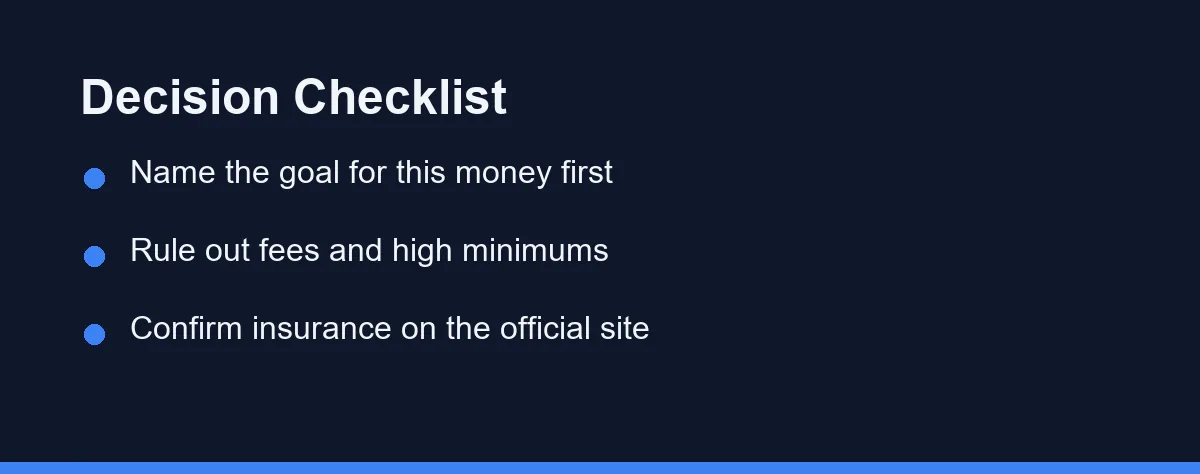
Name the goal first, since it sets the weights. Then drop every account with a monthly fee or a steep minimum, because those rarely justify themselves.
Confirm federal insurance next, using the bank’s official site or the regulator’s database. Compare the survivors on rate, reading the terms behind the number rather than the number alone.
Finally, test the experience. Open the account, link checking, and run a small transfer to gauge speed. Our best budgeting apps guide helps automate deposits once it is set up.
Which Account Fits Your Goal
The framework guides the choice. These are the direct calls for the savers who ask most often.
The saver building an emergency fund: Favor access and safety over rate. Choose a no-fee, federally insured account with fast transfers to checking, so the money is available the moment you need it. A slightly lower yield is worth the reliability.
The saver working toward a purchase: Lean on a strong, sustained rate with no fees. A no-minimum account lets you add money over time, and automation keeps the goal on track. Confirm the rate is not a short promotion first.
The first-time saver: Keep it simple with a no-fee, no-minimum, insured account and an easy app. Building the habit matters more than the exact rate, and you can upgrade later once saving is routine.
The saver with a larger balance: Compare rate tiers carefully, since some accounts pay more above a threshold. Confirm your balance qualifies for the advertised rate on the official site, as of 2026, and watch for any cap.
The saver unsure where to start: Rule out fees and minimums, confirm insurance, then pick the account with the best balance of rate and easy access. Our high-yield savings vs money market guide helps if you are weighing account types.
Balance Beats Yield
The account worth opening is the one with no weak row, not the one with the biggest number. Rate, fees, minimums, access, and insurance all have to clear at once.
Let the job of the money set the weights. Safety nets lean toward speed and protection, while dated goals can lean toward yield. Matching the account to its purpose outperforms chasing a leaderboard.
Whichever you pick, rule out fees and steep minimums, confirm federal insurance, and read the terms behind the rate. A steady, no-cost, insured account serves most savers well for years.
Confirm current rates, fees, and terms on the bank’s official site, since these move often. This article is for general education only and is not financial advice. For related reading, see our guides on best high-yield savings accounts and are high-yield savings accounts worth it.
FAQ
What should I look for in a high-yield savings account?
Look past the headline rate first. A high-yield savings account is a good fit when it has no monthly fee, a low or no minimum balance, federal deposit insurance, and easy transfers to your checking account. The rate matters, but access and cost matter just as much. Compare these factors together rather than chasing the single highest number you see.
Is the account with the highest interest rate always the best choice?
Not necessarily, because a rate can come with strings attached. A slightly lower rate with no fees, no minimum, and fast transfers can leave you better off than a top rate that requires a large balance or charges maintenance fees. Weigh the rate against the account's rules and how easily you can reach your money before deciding.
Is my money safe in an online high-yield savings account?
Yes, as long as the bank carries federal deposit insurance, your money is protected up to the legal limit per depositor, per bank. That protection covers both online and traditional banks that participate. Always confirm the insurance status on the bank's official site or the regulator's database before opening an account, especially with a name you do not recognize.
Can the interest rate change after I open the account?
It varies by bank, and the rate you see when you open the account is not locked. High-yield savings rates are variable and move with broader interest rates, so your return can rise or fall over time. Do not choose a bank on a promotional rate alone; check whether the everyday rate stays competitive after any introductory period.
Is a high-yield savings account worth it for everyday savers?
For most people, yes, because a high-yield account pays far more than a typical checking or basic savings account while keeping your money accessible. It suits an emergency fund or short-term savings goal. It is not meant for money you need to spend daily or for long-term growth, where other tools may fit better.
Sources
- FDIC: Understanding Deposit Insurance — checked 2026-09-27
Some links may be affiliate links. We may earn a commission at no extra cost to you.
How this article was made: it was drafted with AI assistance from the official sources listed above, and its figures were checked against those pages on the dates shown. It is not based on personal hands-on testing.
Comments
Post a Comment