HSA vs FSA: Which Health Account Follows You to Your Next Job

The One Difference That Decides Most of This

If you can stay on a high deductible health plan, choose the HSA. The money is yours permanently, and the 2026 limits are $4,400 for self-only coverage and $8,750 for family coverage. A health FSA caps at $3,400 in 2026, and whatever you do not spend mostly vanishes in December. At best the plan lets you carry $680 into the next year.
The FSA still wins one situation outright. It does not require a high deductible plan, so anyone on a low deductible plan can use it when the HSA is simply not available.
Why the Deductible on Your Health Plan Comes First
Eligibility runs one direction only. You do not pick the account and then hunt for a plan, because the plan you already have decides which account you may use.
For 2026 the IRS defines a qualifying high deductible health plan as one with an annual deductible of at least $1,700 for self-only coverage or $3,400 for family coverage. The same rules cap that plan at $8,500 in out-of-pocket costs for self-only coverage and $17,000 for family coverage.
An FSA asks none of this. If your employer offers one, you can elect it alongside almost any group health plan, which is why it remains the only option for many people.
The 2026 Numbers Side by Side
Both accounts spend pre-tax dollars on medical costs. Everything else about them differs, and the table below is the fastest way to see how far apart they sit.
| What you are comparing | HSA | Health FSA |
|---|---|---|
| 2026 contribution limit | $4,400 self-only, $8,750 family | $3,400 per employee |
| Catch-up at age 55 or older | Extra $1,000 per person | None |
| Health plan required | Qualifying HDHP, deductible of $1,700 or more | Most employer health plans |
| Unused balance in December | Rolls forward in full, no cap | Forfeited unless the plan allows a carryover of up to $680 |
| If you change employers | The account leaves with you | Coverage normally ends with the job |
| Who holds the account | You do | Your employer sponsors the plan |
| Access to the full election | Only what you have contributed so far | The whole annual election on day one |
The last row is the one people miss, and it matters more than the limits do.
The Rule That Makes an FSA Better in a Surgery Year
An FSA gives you the entire annual election on the first day of the plan year. Elect $3,400 in January, need dental work in February, and the full amount is available even though payroll has withheld only a fraction of it.
An HSA offers no such feature. You can spend only what has actually landed in the account, which makes January thin for anyone starting from zero.
That single mechanic flips the comparison in a year with a known, dated expense. A scheduled surgery, orthodontics, or a planned birth all argue for the account that fronts the money.
What Happens to the Money on Your Last Day
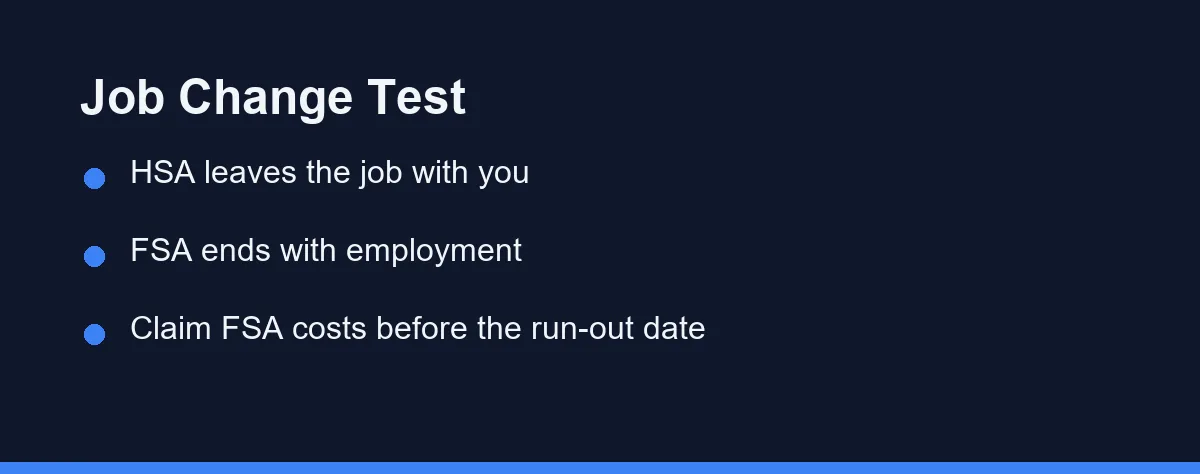
An HSA is a bank or brokerage account in your name. Changing jobs, losing a job, or leaving work entirely does not close it, freeze it, or forfeit a dollar of it.
A health FSA is an employer plan. Employment ends and the arrangement ends with it, though most plans let you submit claims for costs incurred before your last day during a short run-out window.
This asymmetry explains why people describe the HSA as a retirement account wearing a medical label. Only one of the two survives a career.
Three Tax Breaks, and Why Only One Account Gets All of Them
Contributions to either account escape income tax, and money spent on qualified medical costs comes out untaxed. That is two breaks, and both accounts have them.
The HSA adds a third. Because the balance never expires, it can sit invested for years and the growth escapes tax as well, provided withdrawals go to qualified medical costs.
An FSA cannot reach that third break in any meaningful way. Money you must spend within twelve months has no time to compound.
Payroll Tax Is the Break Nobody Mentions
Where you route the contribution changes what you save, and the difference is larger than most people expect.
Money that goes into an HSA through your employer cafeteria plan skips federal income tax and skips Social Security and Medicare tax as well. The employee share of those payroll taxes runs 7.65 percent, made up of 6.2 percent for Social Security and 1.45 percent for Medicare.
Contribute to the same HSA directly from your checking account and the outcome differs. You still deduct the contribution on your return, but the payroll taxes were already withheld from that paycheck and you do not get them back.
On a $4,400 self-only contribution that gap is worth roughly $337 in a year. It costs nothing to capture, since the only requirement is electing the contribution through payroll rather than moving money yourself.
An FSA always runs through payroll, so it always collects this break. That makes the payroll question an HSA question, and it is the single easiest thing to fix at open enrollment.
One caveat applies to self-employed readers. Without an employer cafeteria plan there is no payroll route, so the income tax deduction is the whole benefit.
The Receipt Habit That Turns an HSA Into a Long-Term Account
An HSA has a feature no other account offers, and almost nobody uses it. You can pay a medical bill out of pocket today and reimburse yourself from the account years later.
The conditions are narrow but simple. The expense has to be incurred after the HSA was established, and you cannot have deducted it or been reimbursed for it somewhere else.
Publication 969 sets out those conditions and does not impose a deadline for taking the distribution. So the balance can stay invested and growing while your receipts pile up in a folder.
The practical version takes about a minute per bill. Save the receipt, note the date, the amount, and the provider, and leave the account alone.
This only works if paying out of pocket does not strain you, which is why an emergency fund belongs ahead of it. The tactic converts an HSA into long-term savings that you can still unlock at any point.
An FSA offers nothing comparable. The money has to be spent inside the plan year, so there is no balance left to leave alone.
The Carryover Number Most People Get Wrong
The maximum health FSA carryover for 2026 is $680, and offering it is optional. Your employer may allow the full amount, a smaller amount, a grace period instead, or nothing at all.
Read the plan document rather than assuming. The designs behave differently at year end, and a wrong assumption produces the December scramble for reimbursable purchases.
Two more details deserve a look in the same sitting. Whether your plan grants a run-out period for late claims, and whether a limited-purpose FSA exists if you want dental and vision coverage next to an HSA.
Which Account Fits Your Year

The right answer moves with your health plan and with the year you expect to have.
You are on a low deductible plan: The FSA is your only option, so the real question is how much to elect. Base it on recurring, predictable costs such as prescriptions and dental visits, not on optimism.
You are on a qualifying HDHP and expect a quiet year: Take the HSA and treat it as long-term savings. Contributing even part of the $4,400 self-only limit builds a balance that follows you between jobs, and it compounds the way a long-held savings cushion does.
You have a dated, expensive procedure ahead: The FSA front-loading rule earns its keep here. Elect close to the real cost, since the full amount is available before payroll has withheld it.
You are 55 or older and still on an HDHP: The extra $1,000 catch-up per person makes the HSA hard to beat. Married couples need two accounts to claim two catch-ups.
Your employer offers both: Ask whether the FSA is limited-purpose. If it covers dental and vision only, you can run it next to an HSA without losing eligibility.
Mistakes That Surface in December
Over-electing an FSA is the classic one. People elect the maximum, spend far less, and forfeit the difference to a plan that will not negotiate.
Enrolling in a general-purpose FSA while intending to fund an HSA costs more. The FSA counts as other coverage and blocks HSA contributions for those months, and the fix is far easier before open enrollment than after.
The quiet mistake is leaving an HSA entirely in cash. A balance you will not touch for a decade behaves like the long-horizon money in your retirement accounts, and most custodians offer an investment option once you clear a minimum.
What to Check Before Open Enrollment Closes
Start with the plan, not the account. Confirm whether the plan you are choosing meets the 2026 HDHP floor of $1,700 for self-only coverage or $3,400 for family coverage.
Then price the year honestly. Add up the past year of prescriptions, dental work, and copays, and start from that figure rather than the maximum election, the same way a working monthly budget starts from real spending.
Finally, read the two sentences in your plan document that cover year end. Carryover, grace period, or neither is a $680 question, and it takes about a minute to answer.
The IRS updates these figures every year, so confirm the current amounts in IRS Publication 969 and the 2026 inflation adjustments in Revenue Procedure 2025-19 before you lock in an election.
FAQ
Can you have an HSA and an FSA at the same time?
Not a general-purpose health FSA. Enrolling in one makes you ineligible to contribute to an HSA, because the FSA counts as other health coverage. A limited-purpose FSA for dental and vision costs is the exception, and many employers offer one next to an HSA for exactly this reason.
What happens to my HSA if I switch off a high deductible health plan?
You keep the balance and can still spend it on qualified medical costs. You simply stop contributing for any month you are not covered by a qualifying high deductible plan. Nothing is forfeited, and the account does not close.
Do I lose my FSA money if I leave my job in the middle of the year?
Usually yes for the FSA. The plan ends with employment, though you may claim costs incurred before your last day, and some employers offer COBRA continuation. The HSA is unaffected because you own it directly.
Is the HSA family limit per person or per household?
The family limit of $8,750 for 2026 applies to the family coverage, not to each person. Spouses covered by the same family plan share it. The extra $1,000 catch-up at age 55 or older is per person, so each spouse needs a separate HSA to use both.
Does HSA money really avoid tax three separate times?
Yes. Contributions reduce taxable income, growth is untaxed, and withdrawals for qualified medical costs are untaxed. After age 65 a withdrawal for something other than medical care no longer carries the extra penalty, though ordinary income tax still applies. IRS Publication 969 sets out the details.
Some links may be affiliate links. We may earn a commission at no extra cost to you.
This article was written with AI assistance. It is researched and fact-checked, not based on personal hands-on testing unless explicitly stated.
Comments
Post a Comment