FSA Carryover or Grace Period, and What Each One Does to Leftover Money

A Carryover Protects Small Balances Longer
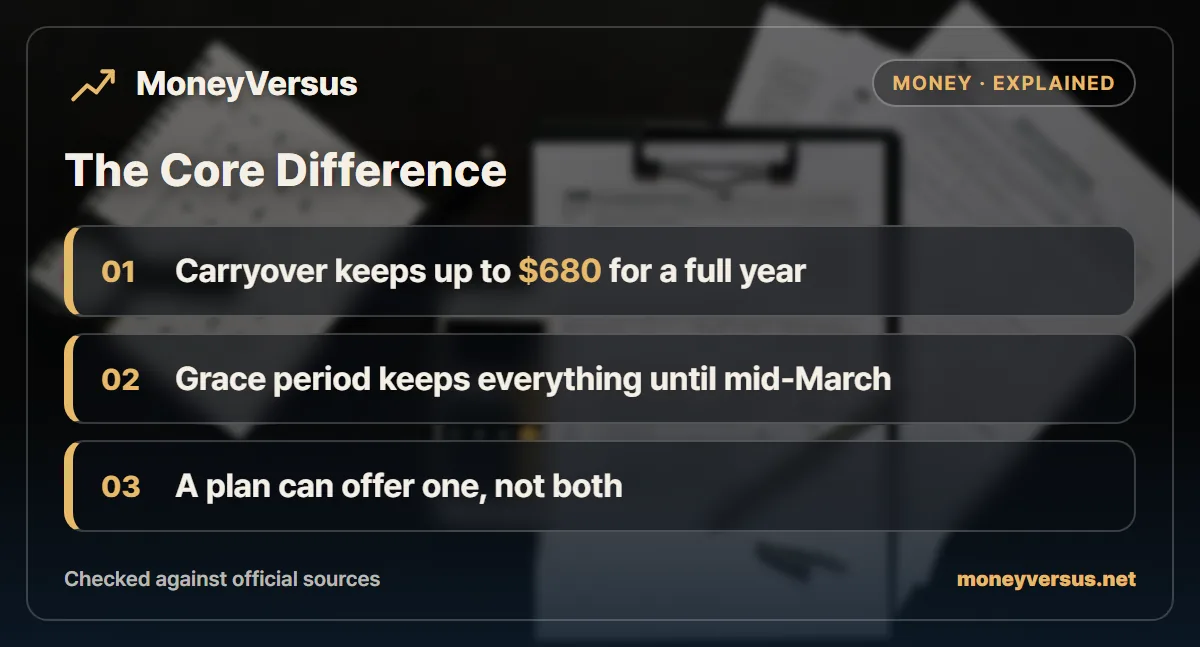
A carryover keeps up to $680 of unspent 2026 money for all of 2027. A grace period keeps every dollar, but only until about March 15. If your leftover is small, the carryover is safer. If it is large and you can spend it early in the new year, the grace period saves more.
You do not get to choose between them. Your employer picks one design or neither, and IRS rules forbid a health FSA from offering both. The job during open enrollment is to find out which one you have and size your election around it.
Why Leftover FSA Money Is a Problem at All
A health FSA is a use-it-or-lose-it account. IRS Publication 969 says amounts left at the end of the plan year generally cannot move to the next year.
The carryover and the grace period are the two exceptions the IRS permits. Each softens the forfeiture rule in a different direction, one by amount and one by time.
Without either, the only cushion is the run-out period. That window lets you file claims late for costs you already incurred, but it does not let you spend the money on anything new.
The Two Designs Side by Side
The table uses the limits for plan years beginning in 2026, from Revenue Procedure 2025-32, and the 2027 figures from the IRS release of November 5, 2026.
| Question | Carryover | Grace period | Neither |
|---|---|---|---|
| How much survives year end | Up to $680 in 2026, $700 in 2027 | The full leftover balance | Nothing beyond late claims |
| How long it lasts | The entire next plan year | Up to 2 1/2 months | Run-out window for old claims |
| Typical deadline | December 31 of the next year | March 15 for a calendar plan | Set by the plan, often 90 days |
| Counts against new election | No | No | Not applicable |
| Spend on new expenses | Yes, during the next year | Yes, until the grace period ends | No |
| Allowed with the other design | No | No | Not applicable |
The limit row is where most people misread their plan. The $680 is a ceiling, and an employer may set a lower carryover such as $500.
The time row matters just as much. A grace period is generous with dollars and stingy with weeks, so it suits only people who can spend fast.
How a Carryover Works in Practice
Suppose your 2026 plan has a carryover and you finish December with $400 left. That $400 shows up in your 2027 account on top of whatever you elect for 2027.
The 2027 health FSA limit is $3,500, and the carryover does not eat into it. Elect the full $3,500 and your 2027 balance can reach $4,200 with a maximum carryover.
Anything above the carryover cap is forfeited. Finish with $900 and the plan keeps $680 for you, then loses the other $220.
How a Grace Period Works in Practice
With a grace period, the whole leftover balance stays available into the new year. Publication 969 allows up to 2 1/2 months after the plan year ends.
The catch is what the money can pay for. It covers expenses you incur during the grace window, such as a January dental cleaning or a February prescription refill.
Whatever you have not spent when the window closes is forfeited. There is no second extension, and the leftover does not roll into the rest of the year.
Three Leftover Balances Run Through Both Rules

Here is how the designs treat three year-end balances on a 2026 calendar plan. The amounts are illustrative, and the spending assumptions are noted in each row.
| Leftover on Dec 31 | Spending Jan 1 to Mar 15 | Kept with carryover | Kept with grace period |
|---|---|---|---|
| $500 | $250 in early-year costs | $500, usable all year | $250, the rest forfeited |
| $1,100 | $1,100 in planned dental work | $680, $420 forfeited | $1,100, nothing forfeited |
| $1,100 | Nothing planned | $680, $420 forfeited | $0, all of it forfeited |
The first row favors the carryover. A small balance has a full year to find a use, while the grace period forces you to spend it in 10 weeks.
The second row favors the grace period. A large balance with a known early expense escapes forfeiture entirely, which a $680 cap cannot match.
The third row is the warning. A grace period with no early plans loses everything, so the design only helps people who can name what they will buy.
What an Over-Election Really Costs
Forfeiting money hurts less than it looks, because the FSA dollars were never taxed. The true cost of each forfeited dollar is the dollar minus the tax you avoided on it.
Take someone in the 22% federal bracket who also skips 7.65% in Social Security and Medicare tax. Each dollar of FSA money saves about 30 cents in tax.
| Item | Calculation | Result |
|---|---|---|
| Tax saved per FSA dollar | 22% + 7.65% | About $0.30 |
| Real cost of each forfeited dollar | $1.00 - $0.30 | About $0.70 |
| Over-election of $420 | $420 x 0.70 | About $294 lost |
| Over-election of $1,100 | $1,100 x 0.70 | About $770 lost |
State income tax would shrink those figures a little further. Still, a forfeiture is a real loss, and it grows faster than the tax savings that justify a large election.
The Uniform Coverage Rule Changes the Math
A health FSA makes your full annual election available from the first day of the plan year. You can spend the whole amount in January, before payroll has withheld most of it.
That front-loading is the reason to elect generously when you have a dated expense. A planned crown, new glasses, or orthodontic work can be booked early without waiting for the balance to build.
It also means the risk sits at the other end of the year. The election you make in November has to survive until the following December, under whichever year-end rule your plan uses.
The HSA Trap Hidden in Both Designs
Anyone moving to a high deductible health plan needs to check the leftover first. A general-purpose health FSA counts as other coverage, which can block HSA contributions.
Publication 969 allows HSA eligibility during a grace period if the prior-year FSA balance is zero. Spend the leftover before December 31 and the grace period stops being a problem.
A carryover into a general-purpose FSA raises the same issue for the new year. Ask whether the plan can move the carryover into a limited-purpose FSA, which covers dental and vision only and leaves HSA contributions open.
Our comparison of an HSA and an FSA covers the wider choice. The HSA last-month rule explains what happens if you switch plans mid-year.
Which Year-End Rule Fits Your Spending

If your medical costs are steady and predictable: A carryover fits. Recurring prescriptions and routine visits leave small, uneven leftovers, and a full year is enough to absorb them.
If you have big costs clustered early in the year: A grace period fits. Dental work, contact lens orders, or a January procedure can soak up a large balance in the first 10 weeks.
If your plan has neither design: Elect conservatively. Base the figure on last year of receipts rather than the $3,400 maximum, the same way a working monthly budget starts from real spending.
If you are moving to a high deductible plan next year: Spend the leftover to zero by December 31. That keeps the grace period from blocking HSA contributions in early 2027.
If you are leaving your job: A carryover or grace period rarely helps. Health FSA coverage usually ends with employment, so the run-out window for old claims is what matters.
If you are a working parent: Check the separate dependent care FSA rules too. Our guide to a dependent care FSA versus the child care credit covers that account.
Questions to Ask HR Before Open Enrollment Closes
Three answers decide your election, and all three sit in the summary plan description. Ask for them in writing if the benefits portal does not show them.
First, does the plan offer a carryover, a grace period, or neither? Second, if it offers a carryover, is the cap the full $680 or a smaller figure?
Third, how long is the run-out period for filing claims? A plan with no carryover but a generous run-out still lets you recover December receipts in January.
Set the Election From Last Year of Receipts
Pull every medical, dental, and vision receipt from the past 12 months and total them. Add any expense you already know is coming, then subtract anything that will not repeat.
Compare that total with your plan design. A carryover plan can absorb a cushion of up to $680, while a grace-period plan rewards an election matched to known early costs.
Treat the leftover like any other savings target you can forecast, the way a sinking fund plans for a known bill. The IRS updates these limits every year, so confirm current figures in IRS Publication 969 before you enroll.
FAQ
Can an FSA have both a carryover and a grace period?
No. IRS Publication 969 says a plan that adopts a carryover is not permitted to also offer a grace period for its health FSA. Your employer picks one design, or neither, and the plan document says which.
How much FSA money can carry over into 2026 and 2027?
For plan years beginning in 2026, the maximum health FSA carryover is $680, set by IRS Revenue Procedure 2025-32. For 2027 it rises to $700. An employer may set a lower figure or offer no carryover at all.
How long is an FSA grace period?
The IRS allows a grace period of up to 2 1/2 months after the plan year ends. For a calendar-year plan that usually means March 15. Expenses you incur in that window can be paid from the leftover balance.
Does carried-over FSA money count against the new year limit?
No. The 2026 salary reduction limit of $3,400 does not include any amount carried over from the prior year. You can elect the full new amount and still keep a carryover of up to $680 on top of it.
What is the difference between a grace period and a run-out period?
The run-out period is a deadline for filing claims, not for spending. It lets you submit receipts for expenses incurred during the plan year after the year has ended. A grace period lets you incur new expenses after the year ends.
Sources
- IRS: Revenue Procedure 2025-32 (2026 health FSA limit and carryover) — checked 2026-11-17
- Publication 969, Health Savings Accounts and Other Tax-Favored Health Plans — checked 2026-11-17
- IRS: Tax inflation adjustments for tax year 2027 (IR-2026-133) — checked 2026-11-17
Some links may be affiliate links. We may earn a commission at no extra cost to you.
How this article was made: it was drafted with AI assistance from the official sources listed above, and its figures were checked against those pages on the dates shown. It is not based on personal hands-on testing.
Comments
Post a Comment